
Siddarth Sethia
*The Union Government Must Respond Swiftly to Karnataka’s Pending Proposals.
*When the State’s Interests Are at Stake, Political Differences Must Be Set Aside.
*MPs Should Work Together to Secure Approval for Karnataka’s Development Projects.
*Deputy Chief Minister Dr.G.Parameshwara Appeals at the All-Party Meeting of Karnataka MPs in New Delhi.
New Delhi:Deputy Chief Minister Dr.G.Parameshwara said that Karnataka is facing a severe drought and that the State Government has already written to the Union Government seeking assistance and requesting relaxation of the norms for declaring drought-affected areas.
However, no response has been received so far.He urged all Members of Parliament representing Karnataka to press the Union Government on this issue.
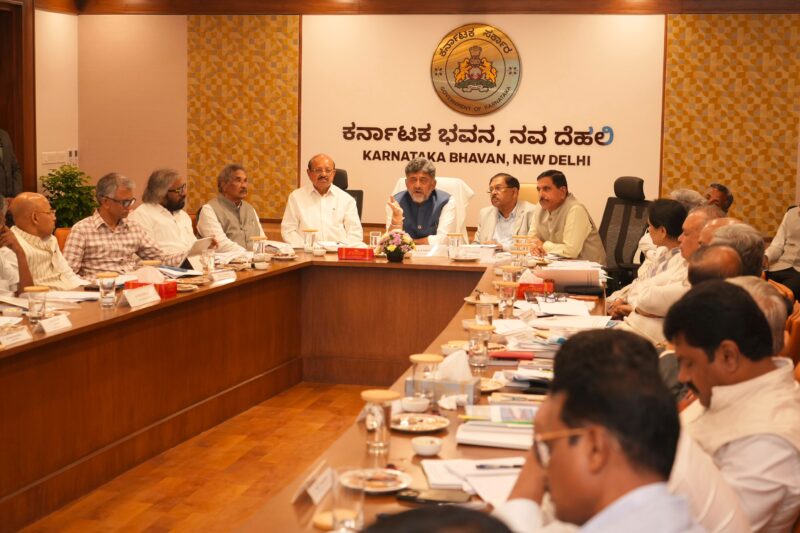
Speaking at the meeting of Karnataka’s Lok Sabha and Rajya Sabha Members held at Karnataka Bhavan in New Delhi today, he said the gravity of the situation facing the State cannot be overstated.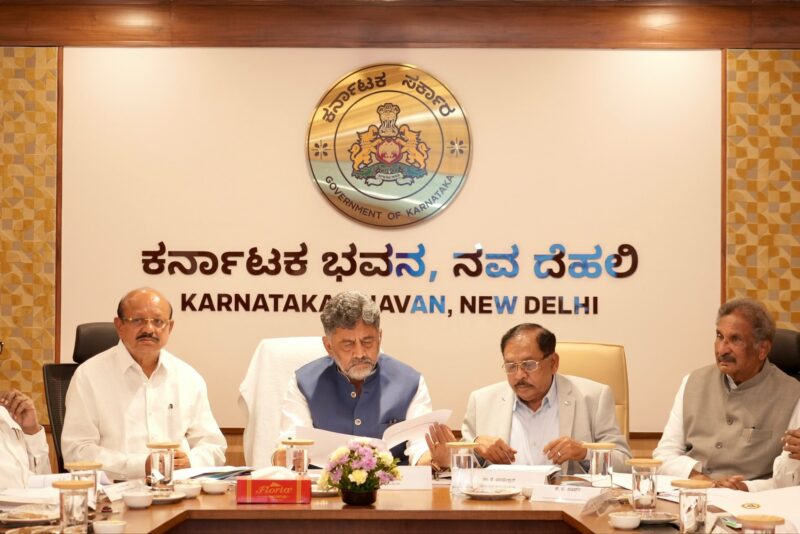
The drought is not only affecting agriculture but also poses a serious threat to drinking water security, urban infrastructure, rural livelihoods, and the overall economy of Karnataka.
“We have not gathered here today merely as representatives of different political parties.We are here as representatives of the people of Karnataka.
Whenever the interests of our State are at stake,we must rise above party lines and stand united.That is what the people who elected us expect from us,”he said.
He added that while political ideologies may differ, the commitment to Karnataka’s development must remain unquestionable.
It is in this spirit of unity that the meeting has been convened to present the State’s key development priorities and the proposals pending before the Union Government.
Dr.Parameshwara appealed to all MPs to set aside political differences,place Karnataka’s interests above everything else, and strongly advocate the State’s legitimate demands in Parliament and before the Union Government.
He said that whether in government at the Centre or in the State, Karnataka has always upheld the principle of cooperative federalism with the utmost respect.
For Karnataka,cooperative federalism is not merely a constitutional phrase but a guiding principle for nation-building.
He clarified that the State’s appeal is not politically motivated but is a constitutional demand for justice and equitable development.
“Karnataka is not asking for charity from anyone. We are only seeking what is rightfully due to the State under the federal framework,”he asserted.
Highlighting the seriousness of the drought, he noted that by July 26, Karnataka should normally have received 427 mm of rainfall, but had received only 279 mm, representing a 35% rainfall deficit. The deficiency is statewide, with:
Malnad: 42% deficit.
South Interior Karnataka: 36% deficit.
Coastal Karnataka: 30% deficit.
North Interior Karnataka: 27% deficit.
He further pointed out that regions which traditionally receive the highest rainfall have experienced unprecedented deficits this year.
According to rainfall data from the past 50 years, this June has been recorded as the fourth driest June on record. Prolonged dry spells followed by isolated heavy rainfall have provided little agricultural benefit and instead worsened farmers’ distress.
District-wise data reveal the severity of the crisis. Nearly 90% of Karnataka’s districts are experiencing deficient or severely deficient rainfall.
At the taluk level, 169 taluks fall under deficient or severely deficient rainfall categories, while 630 hoblis have reported rainfall shortages.
Weather forecasts also indicate that El Niño conditions are likely to strengthen further during the remaining monsoon season, increasing the likelihood of below-normal rainfall.
Only 55% of the intended Kharif sowing area has been covered so far, and in 25 districts, sowing is below 75% of the normal target. Karnataka, one of India’s leading producers of pigeon pea (tur), faces a serious setback as delayed sowing threatens not only farmers’ livelihoods but also the country’s pulse production and food security.
The horticulture sector has been affected even more severely, with only 35% of the seasonal sowing target achieved. Crop-wise progress stands at:
Chilli: 20%.
Onion: 30%.
Tomato: 37%.
Dr.Parameshwara also expressed concern over the State’s water resources.
The 14 major reservoirs in Karnataka are only 49% full. The Krishna Raja Sagara (KRS) Reservoir is at 34% of capacity,while the Tungabhadra Reservoir stands at 29%.
Since the Cauvery catchment itself has received deficient rainfall,inflows into reservoirs remain uncertain.
He said that major projects such as the Upper Bhadra Project would provide irrigation to more than 2.25 lakh hectares, replenish 367 lakes,and offer a permanent solution to some of Karnataka’s most drought-prone regions.
Similarly, the Mekedatu Project is crucial not only for meeting Bengaluru’s future drinking water needs but also for regulating river flows amid increasing climate variability.
Delays in approving these projects are weakening Karnataka’s ability to tackle recurring droughts.
Referring to the Krishna Water Disputes Tribunal-II, he said that although the award was delivered over a decade ago, the Gazette notification is still pending.
As a result, Karnataka has been unable to utilise its rightful share of 173 TMC of water, affecting irrigation for nearly 5.94 lakh hectares in North Karnataka. Lakhs of farmers continue to wait for justice.
He also stressed the importance of the Kalasa-Banduri Project for improving drinking water supply in North Karnataka.
Although the Detailed Project Report (DPR) has been approved and all required clarifications submitted, clearance from the Wildlife Department is still pending. He sought the MPs’ support for its early implementation.
The Deputy Chief Minister further demanded that Karnataka receive its fair share of water under the Inter-Linking of Rivers programme.
As one of India’s most drought-prone States, Karnataka requires adequate water allocation to ensure long-term water security,irrigation,and resilience against climate change.Pending approvals from the Union Government are therefore of critical importance.
On the economic front, he noted that Karnataka attracted USD 13 billion in Foreign Direct Investment (FDI) equity inflows during 2025–26, nearly doubling the previous year’s investment.
This growth has been driven by major investments in technology,data centres,and Global Capability Centres (GCCs),strengthening Karnataka’s position as one of India’s fastest-growing investment destinations.
He emphasised that the Bengaluru Suburban Rail Project is essential for reducing congestion in one of India’s fastest-growing cities.
While the State Government has already made substantial financial commitments,necessary approvals and matching support from the Union Government are still awaited.Timely decisions would directly benefit millions of daily commuters.
Dr. Parameshwara also highlighted the proposed Bengaluru–Mumbai High-Speed Rail Corridor, stating that it has the potential to transform regional connectivity, strengthen industrial growth, and attract investments across Karnataka.
He appealed to all MPs to collectively work towards securing timely approval for this landmark project.
Turning to North Karnataka,he urged attention to the proposed Vijayapura Airport, noting that key regulatory approvals remain pending.
Early approval would significantly improve connectivity and open new opportunities for investment and economic development in the region.He requested MPs to strongly pursue the project’s approval in Parliament.
He further pointed out that the Kolar Railway Coach Factory was announced several years ago and that the Karnataka Government has already provided 1,123 acres of land for the project.
However,implementation has yet to begin.Reviving the project would create thousands of jobs and accelerate industrial development in the region.
Finally,he highlighted the importance of the Tumakuru–Rayadurg Railway Line,stating that improved rail connectivity would benefit not only Tumakuru district but also large parts of Central and North Karnataka.
Timely financial support for the project, he said, would be a significant investment in Karnataka’s future development.


