
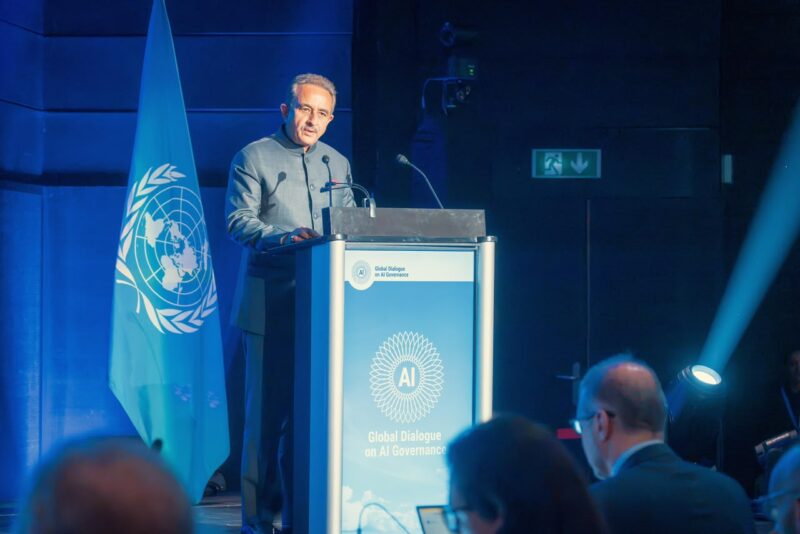
Geneva/New Delhi: India reaffirmed its commitment to responsible, inclusive, and human-centric Artificial Intelligence (AI) governance at the First United Nations Global Dialogue on AI Governance, held in Geneva, Switzerland, from 6–8 July. The Indian delegation was led by Minister of State for External Affairs Kirti Vardhan Singh, who presented India’s vision for ensuring that AI remains safe, transparent, ethical, and beneficial for all.
The landmark dialogue, established under the United Nations General Assembly Resolution 79/325, is one of the key outcomes of the Global Digital Compact adopted in 2024. The forum brought together representatives from governments, international organizations, industry, academia, and civil society to discuss the future of global AI governance and develop a collaborative framework for the responsible development and deployment of Artificial Intelligence.
The conference focused on several critical issues, including the social and economic impact of AI, trustworthy and secure AI systems, reducing digital inequalities, protecting human rights, and strengthening international cooperation in AI governance.
Addressing the gathering, Kirti Vardhan Singh described Artificial Intelligence as not merely a technological advancement but a transformative force capable of reshaping societies and economies worldwide. He emphasized that the governance of AI must be guided by shared responsibility, transparency, accountability, and global cooperation to ensure that its benefits reach all sections of humanity.
Presenting India’s perspective, the Minister said that responsible AI governance should be built on human oversight, respect for human rights, ethical innovation, and safeguards against the misuse of technology. He noted that these principles were also highlighted during the recently held India AI Impact Summit, reflecting India’s commitment to developing safe, secure, and trustworthy AI ecosystems.
Highlighting India’s national AI strategy, Singh reiterated the country’s vision of “AI for All,” aimed at promoting innovation while ensuring that the benefits of Artificial Intelligence are accessible to every section of society. He stressed the importance of strengthening the capacities of developing countries and bridging technological and resource gaps to enable equitable participation in the global AI ecosystem.
Calling for greater international collaboration, the Minister said the United Nations remains the most appropriate platform for building global consensus on AI governance. He observed that while machines are not influenced by borders, ideologies, or political differences, human divisions can hinder technological progress. Therefore, diplomacy and international cooperation must advance alongside technological innovation.
Concluding his address, Singh stated that the decisions taken today by governments, international institutions, and the private sector would determine whether AI becomes a force for inclusive development or deepens existing inequalities. He reaffirmed India’s commitment to contributing actively towards building a secure, trustworthy, inclusive, and human-centric global AI framework.
During the conference, delegates also witnessed the presentation of the first Annual Report of the Independent International Scientific Panel on AI (IISPA), which provides an independent scientific assessment of the capabilities, opportunities, and potential risks associated with Artificial Intelligence. Several thematic sessions were also held to deliberate on the future architecture of global AI governance.
On the sidelines of the summit, Kirti Vardhan Singh delivered the keynote address at the event titled “From India to Geneva – A Global Convening on AI Impact at Scale.” Highlighting India’s inclusive AI approach, he said the country’s objective is not only to emerge as a global leader in AI innovation but also to ensure that the benefits of the technology reach the last person in society while promoting safe, ethical, and responsible AI worldwide.


