Yogesh K Porwar
*Not Only Meetings;We Have Assessed the Situation on the Ground.
*₹420 Crore Available for Drinking Water and Fodder Needs: DyCM.
Despite the severe rainfall deficit in the State, the Government has taken all necessary measures to ensure that people do not face drinking water shortages, including supplying water through tankers,using private borewells and drilling new borewells,Deputy Chief Minister and Revenue Minister Dr.G.Parameshwara said.
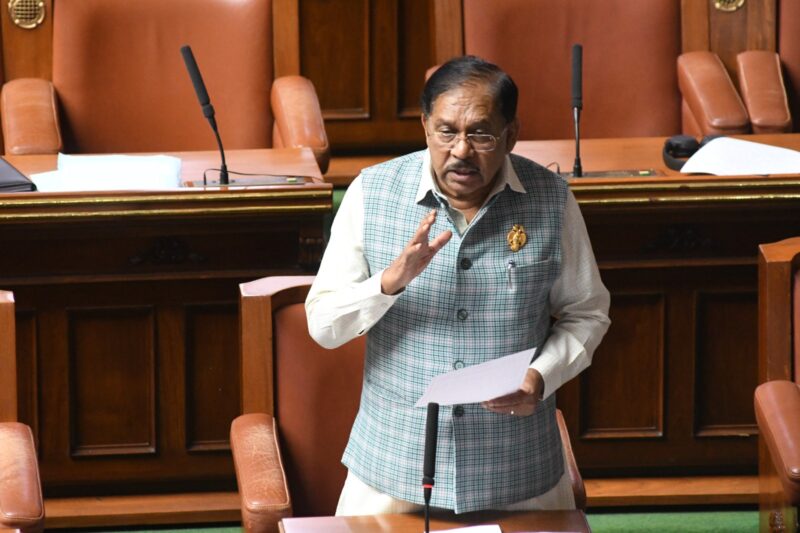
Replying on behalf of the Government during the discussion on the drought situation in the Legislative Assembly,he detailed the rainfall deficit,meetings and field inspections conducted by the Government,water storage in reservoirs,the drinking water situation in rural and urban areas,and the measures taken so far.
State Records Overall Rainfall Deficit of 36% :
Looking at rainfall from June until now,the State normally receives 199 mm in June,but only 116 mm was recorded.
The rainfall was also scattered and not evenly distributed across the State.The overall rainfall deficit in June stood at 42%.
Region-wise, the deficit was 5% in South Interior Karnataka,28% in North Interior Karnataka,58% in Malnad and 49% in the coastal region,he said.
Rainfall improved slightly in July.Against the normal 271 mm, the State received 192 mm, resulting in a deficit of 29%, compared with 42% in June.
In August, the rainfall deficit stood at 23%,with 169 mm recorded against the normal 222 mm. Upto September 23, the State should normally have received 119 mm,but only 47 mm was recorded,a deficit of 61%.
Overall, against the normal rainfall of 809 mm,Karnataka received only 524 mm, resulting in an overall deficit of 36%, he said.
Rainfall deficiency has been categorised across the State. There are no areas under the excess-rainfall category.
174 taluks fall under one category, while areas that received virtually no rain have also been separately identified. Overall, rainfall deficiency is being seen in 222 taluks.
Dr. Parameshwara said allegations had been made that the Government had not held even a single meeting on drought, had failed to focus on the situation and that Ministers were elsewhere.However,the actual figures show otherwise.
Around 270 district-level meetings have been held.The Chief Minister had assigned clear responsibility to all district in-charge Ministers during a Cabinet meeting, directing them to visit their districts,assess the drought and submit reports to the Revenue Minister.
District in-charge Ministers have held 84 meetings. Contrary to claims that no task force meetings were held, a total of 832 task force meetings have taken place.
Overall, 1,160 meetings have been held at the official level. In addition, the Chief Minister has held 8 meetings, the Revenue Minister 9 meetings,and Divisional Commissioners 10 meetings.At the senior level,a total of 25 meetings have been conducted,he said.
Responding to claims that Ministers had not visited districts or conducted meetings, Dr.Parameshwara said Chief Minister D.K.Shivakumar held drought-related meetings in Chitradurga on July 25, Gadag on September 1,Bagalkote on September 4,Bengaluru Division on July 7,and Kalaburagi Division on July 25.
“Whether the Chief Minister travelled by helicopter or plane is irrelevant. What matters is whether drought-related meetings were held.The fact is that such meetings were conducted,”he said.
Severe Rainfall Deficit in Several States:
Dr.Parameshwara said Karnataka was not the only State facing severe rainfall deficiency.While Karnataka has recorded a rainfall deficit of 36%,the deficit stands at 43% in Andhra Pradesh, 21% in Telangana, 22% in Tamil Nadu, 22% in Kerala, 21% in Rajasthan, 39% in Punjab, 22% in Haryana, 36% in Bihar, 28% in Assam, 41% in Arunachal Pradesh, 17% in Maharashtra and 35% in Goa.
Several other States are facing similar conditions, and it would therefore be incorrect to suggest that Karnataka alone is affected,he said.
Within Karnataka, the rainfall deficit stands at 58% in Ballari, 40% in Bidar, 52% in Chikkaballapur, 44% in Davanagere, 45% in Gadag, 51% in Kalaburagi, 49% in Haveri, 52% in Koppal and 45% in Tumakuru.
Vijayanagara has recorded the highest deficit at 63%. Similar deficits of more than 35% have been recorded elsewhere as well,he said.
“When such a severe drought occurs,what can the State Government do?.
We must visit districts, conduct meetings,take necessary measures and give priority to drinking water,”he said.
Karnataka has 14 reservoirs.According to information as of November 17,these reservoirs together held 649 TMC of water, or around 72% of their capacity.
During the same period last year,storage stood at 93%. This year,storage was 72%, and water also had to be released to Tamilnadu in accordance with the Supreme Court’s decision.As a result, reservoir storage has now fallen to around 50%,he said.
In rural areas, according to the latest information, drinking water problems are being faced in 531 villages across 111 taluks.
“We have not remained idle.Water is being supplied through tankers, private borewells and every available water source,” he said.
In urban areas too,around 81 wards across 15 Urban Local Bodies are facing drinking water problems,and necessary measures have already been taken.
Following the Chief Minister’s meeting on April 16, funds were released to Deputy Commissioners through the Rural Development and Panchayat Raj Department.
Smaller districts were provided around ₹3 crore,while larger districts received ₹5 crore to ₹6 crore,with an average allocation of around ₹5 crore.The funds were specifically earmarked for drinking water.
Later, during divisional-level meetings in Belagavi, the Government announced an additional ₹1 crore for every MLA to address growing drinking water needs.
“This was not limited to Congress MLAs.Every MLA received ₹1 crore,”he said.
The funds are now being utilised,with action plans prepared in most places for drilling borewells,extending piped water supply and pipelines,and carrying out hydro-fracturing works.
“So far,we have ensured that there is no crisis over drinking water anywhere.It is incorrect to say that the Government has done nothing,” he said.
The Government has provided ₹117 crore, apart from releasing ₹189 crore through MLAs, and has so far declared 177 taluks drought-hit.
Deputy Commissioners have also been instructed to use the funds available under SDRF wherever required.
Around ₹420 crore is available in the PD accounts of Deputy Commissioners,and they have been directed to utilise it for drinking water and fodder for livestock.
Work is already underway in many places,and the Government is responding immediately wherever drinking water problems arise.
Referring to Tumakuru City Corporation,Dr. Parameshwara said MLA Jyothi Ganesh had brought to his attention that water supply had been disrupted for three days.
He said the disruption was caused by a strike and that alternative arrangements had already been made.
“There is no shortage of water.If routine or administrative problems arise,they must be resolved separately.Administrative issues require a different kind of solution,” Dr.G.Parameshwara said.