Dr.Thomas (Special Correspondent)
Dear Prime Minister Narendra Modi,
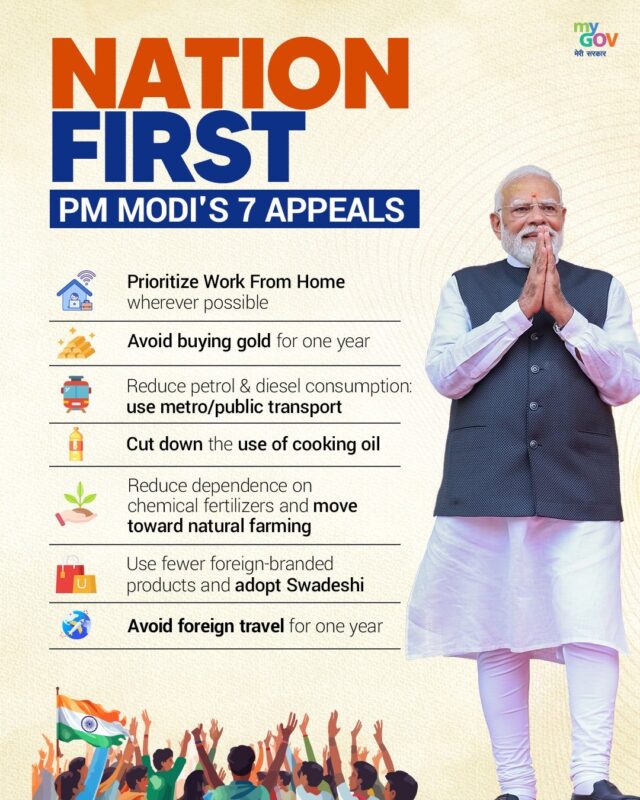
Your recent appeals asking citizens to reduce foreign travel and limit gold purchases have created anxiety among ordinary people across the country.
Many citizens feel that whenever global economic challenges arise, the burden ultimately falls on the common man.
India is already facing rising living costs and economic uncertainty.
Commercial and domestic gas connection issues continue in several regions.
Many hotels and small businesses have shut down due to increasing operational expenses, while those still functioning have significantly increased prices.
If fuel prices rise further, the cost of every essential commodity and service will increase as well. For salaried middle-class families, managing household expenses is becoming increasingly difficult.
As the leader of the nation, people expect the government to create an atmosphere where citizens can live with dignity and stability.
Many believe that ordinary people are continuously being asked to sacrifice while their struggles remain unheard.
During the tenure of former Prime Minister Manmohan Singh, your party strongly criticized rising fuel prices and the falling value of the rupee against the dollar.
Today, citizens are questioning the current situation under your government, where fuel and gas prices continue to rise and the rupee remains under pressure against the US dollar.
Many people remember the nationwide protests and campaigns your party once conducted on these very issues, including demonstrations with gas cylinders on the streets.
The demonetization decision announced overnight was presented as a major step to curb black money.
However, years later, many citizens still question its effectiveness. Critics argue that the move created enormous hardships for ordinary people and small businesses, while its long-term economic benefits remain unclear.
Another major concern is unemployment and migration. Many educational institutions and universities in India are struggling to attract students, while a large number of young Indians are leaving the country in search of better opportunities abroad.
Citizens expect stronger efforts toward job creation, industrial development, and economic growth rather than divisive politics based on religion and caste.
Healthcare and education remain serious challenges. A large section of the population cannot afford quality medical treatment in private hospitals.
There is a growing demand for modern, high-tech government hospitals in every district and free, quality education for children across rural and urban India.
Many people believe that improving healthcare, education, and employment should be the top priority of the government.
There is also criticism that investigative agencies are increasingly being used as political tools against opposition parties and critics of the government.
In a democracy, institutions are expected to function independently and impartially.
Political observers also point to changing electoral trends.In Tamil Nadu, major political developments have shown that voters are open to alternatives and change.
Many analysts note that despite intense campaigns by national parties, regional forces continue to dominate because they connect more closely with local aspirations and language identity.
Language policy is another sensitive issue. Several states strongly value their regional languages and cultural identity.
In Tamil Nadu, people take immense pride in the Tamil language, one of the world’s oldest living languages. Many citizens believe that promoting Hindi should not come at the cost of regional languages.
At the same time, strengthening English education is also important because it helps Indian youth compete globally.
Concerns have also been raised about restrictions under the Foreign Contribution Regulation Act (FCRA). Several NGOs, trusts, hospitals, schools, and rural development organizations have reportedly struggled due to tighter regulations and scrutiny.
Many citizens argue that charitable institutions, including those established by Christian missionaries and social organizations, have historically played a significant role in healthcare, education, and social welfare in remote areas where government support was limited.
Food choices and personal freedom are also subjects of debate. Many citizens feel that dietary habits should remain a matter of personal choice rather than political controversy.
Critics argue that issues such as beef consumption are often politicized despite India being one of the world’s major exporters of beef-related products.
India is a democratic nation built on diversity, freedom, and coexistence.
Citizens expect leadership that unites people, strengthens institutions, improves living standards, and focuses on real issues such as inflation, unemployment, healthcare, and education rather than division and political polarization.
The people of India are not merely seeking promises; they are seeking relief, opportunity, and hope for a better future.