Yogesh K Porwar
*From paperwork and office visits to online,integrated services:e-Aasthi 2.0 puts technology at the centre of citizen-friendly property governance.
*GBA’s upgrades property-record platform;23–24 lakh of Bengaluru’s 35 lakh-plus properties already digitised.
*New system simplifies property services, integrates with Kaveri,BESCOM and BWSSB,enables online tracking and reduces physical visits and dependence on intermediaries.
*From paperwork and office visits to online, integrated services:e-Aasthi 2.0 puts technology at the centre of citizen-friendly property governance.
*“The purpose of technology is to make citizens’ lives easier”:e-Aasthi 2.0 brings property services into a more seamless digital system,says Krishna Byre Gowda.
For most citizens,a property is among the most valuable assets they will own.Yet,managing the records associated with that property can often mean paperwork,repeated visits to government offices,delays and dependence on intermediaries.
The Greater Bengaluru Authority (GBA) is now seeking to change that experience.
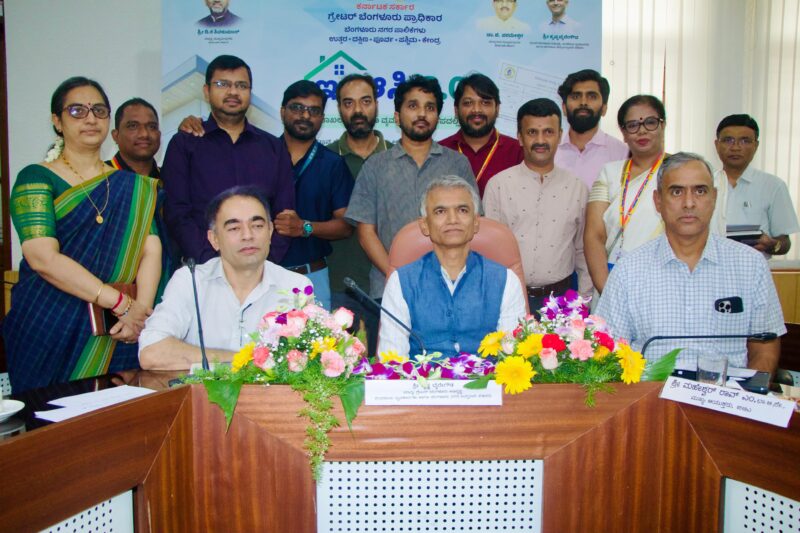
Greater Bengaluru Development Minister,Krishna Byre Gowda today launched‘e-Aasthi 2.0’,the upgraded property-record and e-Khata management system for Bengaluru,bringing greater automation,integration and transparency to one of the most important citizen-government transactions.
The new system is designed to make property-related services simpler,faster,more secure and more citizen-friendly,while reducing the need for physical interaction with government offices.
The upgraded citizen module allows residents to access e-Khata services,submit applications and track their progress online.
23–24 lakh property records already digitised:
Speaking at the launch,Krishna Byre Gowda said Bengaluru has more than 35 lakh properties,of which around 23–24 lakh property records have already been digitised and Draft e-Khatas issued.
Around 11 lakh property owners have already obtained their Final e-Khata.
The Minister said property owners who have not yet obtained their Final e-Khata can complete the process by submitting the required information.
The move towards digital property records builds on Karnataka’s earlier efforts to computerise land and property records,with the objective of reducing errors, delays and unnecessary dependence on intermediaries.
From e-Aasthi 1.0 to e-Aasthi 2.0:
The first generation of e-Aasthi laid the foundation for digital property records.Rolled out in erstwhile BBMP in October 2024,around 25 lakh e-Khatas were scanned, digitised and made available online.
The initiative subsequently received the National e-Governance Gold Award 2025 from the Government of India for technology-enabled and citizen-centric service delivery.
e-Aasthi 2.0 builds on that foundation with a more modern, in-house developed platform incorporating improved user experience,automation,
“Some aspects of the existing system,including the process of uploading documents,were difficult for citizens.
We have therefore worked on e-Aasthi 2.0 to make the system simpler,faster, more transparent and more citizen-friendly,”Byre Gowda said.
Making everyday property problems easier to resolve:
A major focus of the upgraded system is to address the problems citizens commonly encounter in their property records including errors in names,changes in names, continuation of previous owners’names and discrepancies in property extent.
e-Aasthi 2.0 provides structured digital workflows for corrections after e-Khata issuance,with clearer processing and approval trails.
The system also supports multiple deeds relating to the same property, including historical deeds before and after 2004.
Inheritance and mutation processes are also being streamlined through authenticated data and integration with relevant government systems.
Government systems talking to government systems:
One of the significant changes in e-Aasthi 2.0 is its integration with other government systems.The platform is being integrated with Kaveri,BESCOM and BWSSB, enabling relevant registration and property information to be exchanged between systems and facilitating auto-updation of records based on e-Khata.
The objective is simple:citizens should not have to repeatedly carry information from one government office to another when the information is already available within government systems.
The upgraded platform also provides improved application-status tracking,allowing citizens and officials to see the status of applications and enabling better monitoring of pendency and disposal.
Less office visits. Less dependence on intermediaries:
The significance of e-Aasthi 2.0 is ultimately not the technology itself, but what the technology can remove from the citizen’s experience.
The system is designed to reduce manual intervention wherever processes can be automated,strengthen validation using authenticated government data and create a clearer digital trail for applications.
For citizens,this means fewer physical visits,less paperwork,greater visibility of their application and reduced dependence on intermediaries for routine property services.
Property owners living outside Karnataka,including NRIs, can also apply for and obtain e-Khata online from anywhere in the world,subject to applicable verification requirements.
Online bifurcation and other services being added:
The GBA will introduce an online module for Khata bifurcation from September 28th.Under the new module, eligible property owners will be able to apply online, upload the required plans and complete the bifurcation process digitally,subject to applicable rules and approvals.
e-Aasthi 2.0 also provides for New Khata, Bulk New Khata, property bifurcation/sub-division and amalgamation through digital workflows.
The modules are being introduced in phases to ensure continuity of services and a smooth transition from e-Aasthi 1.0.
Building a digital property ecosystem:
The larger ambition goes beyond e-Khata. e-Aasthi 2.0 is being developed as part of an integrated property-management architecture for the GBA and the five Bengaluru City Corporations,bringing together digitised and geo-referenced property records with property tax, urban planning and building-plan approvals, Kaveri,BESCOM,BWSSB,GPS-based property capture and other datasets.The integrated architecture is outlined in the GBA’s brief note.
This creates the foundation for property administration in which different government systems can increasingly work with the same authenticated information rather than asking citizens to repeatedly provide it.
Part of a wider technology-led approach to governance:
The launch of e-Aasthi 2.0 comes as Bengaluru is seeing a wider use of technology to redesign citizen-facing government services.
Nambike Nakshe 2.0, launched recently, has moved eligible residential building-plan approvals towards an automated, rule-based digital process, using information already available through e-Khata.
Similarly, the GBA’s Road Infrastructure Management System (RIMS) is using technology and AI-enabled data collection to create a more scientific approach to monitoring Bengaluru’s road network.
The common thread across these initiatives is not technology for its own sake. It is the attempt to use technology to reduce friction between citizens and government — fewer forms, fewer visits, greater traceability and more predictable processes.
“Technology should make government simpler for citizens”:
“The objective is not technology for the sake of technology.The objective is to use technology to make the citizen’s interaction with government simpler, faster and more transparent,”Byre Gowda said.
With e-Aasthi 2.0, the GBA is seeking to take property administration further in that direction — from merely digitising property records to creating a more integrated, automated and citizen-centric property service.
In simple terms,e-Aasthi 1.0 digitised property records; e-Aasthi 2.0 seeks to make the entire property-record and e-Khata service simpler, more secure, more transparent and more accessible online.
The launch was attended by Chief Commissioner, Maheshwar Rao,Special Commissioner,Muneesh Moudgil,City Municipal Commissioner,Jagadish G,D.S. Ramesh,Pommala Sunil Kumar,Joint Commissioners of the City Corporations and officials from the IT and other departments.