Pramesh S Jain
“Bengaluru Showcases National Model for Treated Water Reuse at NITI Aayog Workshop”.
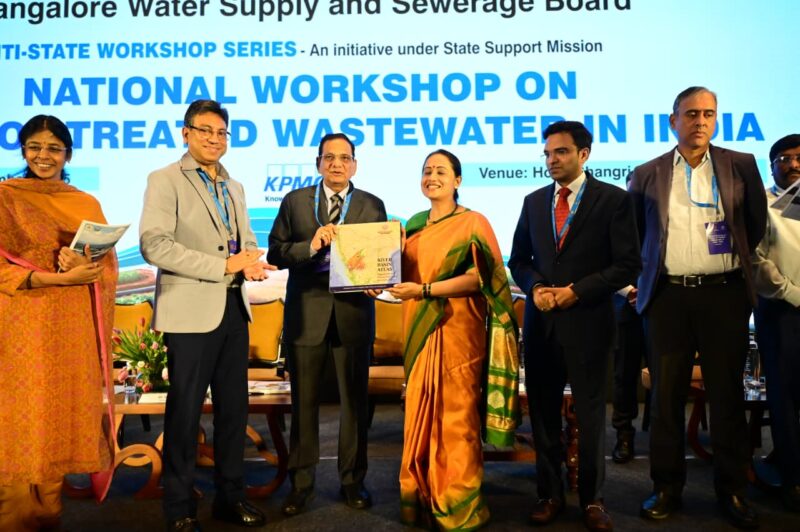 India must urgently adopt a uniform national standard for treated wastewater to ensure quality,safety, and public acceptance across states,said Dr.Vinod K.Paul, Member of NITI Aayog,at the inauguration of the National Workshop on“Reuse of Treated Wastewater in India”held at Hotel Shangri-La,Bengaluru.
Opening his keynote address,Dr.Paul warned that India’s Per-capita water availability has already fallen below 1,400 cubic metres,underlining the need for large-scale wastewater recovery and reuse.
He added that the country must move decisively to achieve 50% reuse by 2030 and 100% reuse by 2045, noting that only 11 states currently have a wastewater reuse policy in place.
The two-day workshop,organised by NITI Aayog in collaboration with the Government of Karnataka and the Bangalore Water Supply and Sewerage Board (BWSSB), brings together delegates from more than 18 states, sector experts,researchers,and policymakers to build a national framework for circular water management.
In her inaugural address,Chief Secretary to the Government of Karnataka,Dr.Shalini Rajneesh,said Bengaluru had turned crisis into opportunity during last year’s severe drought by mandating treated water for non-potable uses and safeguarding drinking-water supply.
She highlighted the revival of 110 lakes,the city’s aggressive push toward 100% sewage treatment by 2028,and the enforcement of rainwater harvesting and treated-water reuse bylaws.
“Treated water is not waste;it is a valuable second resource.Bengaluru has shown what coordinated action can achieve even in adversity,”she said.
Additional Chief Secretary (Urban Development),Tushar Girinath,presented Bengaluru’s technical progress, stating that the city supplies 2,200 MLD of water and recycles nearly 1350 MLD every day through 34 operational STPs,with 12 more under construction.
He emphasised the need to rebrand sewage treatment plants as Resource Recovery Plants,and outlined plans for a dual water grid to separate drinking-water supply and treated-water reuse.
Representing the Ministry of Housing and Urban Affairs, Smt.D.Thara,IAS,stressed the economic importance of treating wastewater as a recoverable asset.
She noted that Bengaluru’s water revenue,currently around Rs.190 crore,could rise to Rs.1,000 crore with structured reuse,metering,and resource-recovery systems.
She called for the creation of professional divisions within BWSSB to manage water accounting and reuse and encouraged active community participation, including monitoring by women’s self-help groups.
“Sustainability begins when every household values every drop,”she said.
Earlier in the session,two films—“BWSSB: A Legacy of Vision and Service”and“Glimpse of Reuse in Bengaluru” —were screened to showcase the city’s progress in water reuse, lake rejuvenation,and technology-driven water management.
Speaking at the inaugural,BWSSB Chairman Dr.V.Ram Prasath Manohar,IAS,said Bengaluru’s reuse systems had become a model for the country.
“Technology,governance,and community support together allow us to convert every litre of wastewater into a resource,”he noted.
Delegates will visit the Cubbon Park Tertiary Treatment Plant and the KC Valley Project to observe Bengaluru’s large-scale treated-water reuse and ecological restoration efforts.