Dr.Thomas (Special Correspondent)
Once celebrated as the“Garden City of India,”Bengaluru earned global recognition as an educational hub and the nation’s IT capital.
Today,however,the city is facing another reality—a growing challenge from narcotics trafficking and drug abuse.
The increasing number of drug seizures and arrests raises serious questions about the safety and future of our youth.
According to official police reports,Bengaluru Police have registered nearly 2,000 cases under the Narcotic Drugs and Psychotropic Substances (NDPS) Act in 2026.
More than 2,500 individuals have been arrested, and narcotics worth over Rs.130 crore have been seized during anti-drug operations.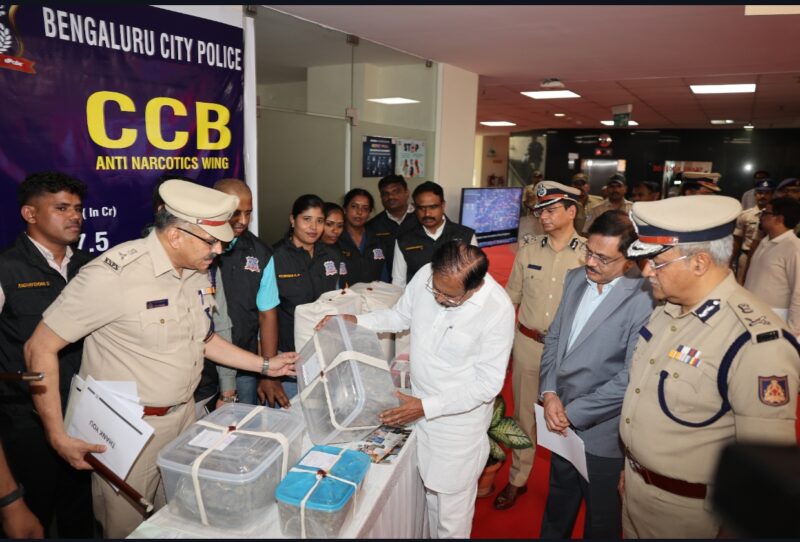
Recent crackdowns alone have resulted in seizures worth Rs.36.67 crore,Rs.23.63 crore,and several other major busts across the city.
The major narcotic substances seized in Bengaluru include:
* MDMA (Ecstasy).
* Ganja and Hydroponic Ganja.
* LSD strips and pills.
* Cocaine.
* Heroin.
* Charas and Hashish Oil.
Law enforcement agencies have repeatedly stated that many of these drug networks specifically target students and young consumers.
Several investigations have revealed attempts to distribute drugs near colleges, hostels,pubs,parties,and entertainment venues.
How Young People Become Trapped:
Drug addiction rarely begins with criminal intent.Many youngsters are introduced to narcotics through peer pressure,parties,curiosity,or social influence.
Once addiction develops,users often become financially dependent on suppliers and may be drawn into illegal activities to fund their habit.
Police investigations across Bengaluru have uncovered organized networks involving interstate and international supply chains.Authorities have arrested both Indian and foreign nationals in various cases.
However,it is important to remember that criminal responsibility lies with individuals involved in illegal activities,not with any nationality or student community as a whole.
Health Consequences of Drug Abuse:
The impact of narcotics on human health is devastating:
* Severe mental health disorders.
* Depression and anxiety.
* Hallucinations and psychosis.
* Memory loss.
* Heart attacks and cardiac complications.
* Organ damage.
* Increased risk of suicide.
* Violent and impulsive behaviour.
* Academic and career destruction.
Medical experts warn that prolonged use of substances such as MDMA,Cocaine,heroin,and synthetic drugs can permanently affect brain function and decision-making ability.
A Growing Criminal Economy
Drug trafficking is not merely a law-and-order problem; it is also an underground economy.
Organized criminal groups use sophisticated methods to transport and distribute narcotics, including courier networks,online communication platforms, hidden compartments, and interstate transportation routes.
Recent Bengaluru police operations have exposed networks operating across multiple jurisdictions,with suppliers sourcing drugs from domestic and international channels before distributing them within the city.
The profits generated from narcotics trafficking often fund other criminal activities, making it essential for authorities to dismantle entire supply chains rather than only arrest street-level peddlers.
Society Must Share Responsibility:
While police enforcement is important, society also has a role to play.
Parents must remain involved in their children’s lives and be alert to behavioural changes.Educational institutions should strengthen awareness programmes and counselling services.
Communities should cooperate with law enforcement agencies by reporting suspicious activities.
Drug abuse is not merely an individual failure;it is a social challenge that affects families,schools, workplaces, and entire communities.
Lessons from Other Regions:
Several Indian states, particularly border regions, have struggled with narcotics-related problems over the years.
Experts have repeatedly warned that widespread addiction among youth can weaken social stability, reduce productivity, and create long-term public health burdens.
A nation’s greatest asset is its young generation. If young people fall victim to addiction,the consequences extend far beyond individual families and affect the country’s future development.
Drug traffickers continuously develop innovative methods to evade law enforcement agencies.In one widely discussed case,police reportedly became suspicious of a young woman travelling on a bus because of her unusual attachment to a doll she carried throughout the journey.
Upon inspection,narcotics worth a substantial amount were allegedly found concealed inside the doll.While the details of such cases vary,they highlight how criminal networks use ordinary objects,including toys,gifts, luggage,food packets,and courier parcels, to transport illegal substances.
Similar incidents have been reported across India, where drugs were hidden inside dolls, lunch boxes, chocolates, clothing, and other everyday items to avoid detection by authorities.
Such cases demonstrate the sophistication of modern drug trafficking networks and the challenges faced by law enforcement agencies in combating them.
The government should continue strengthening anti-narcotics operations through:
* Strict enforcement of the NDPS Act.
* Faster prosecution of major traffickers.
* Better surveillance of trafficking networks.
* Increased coordination between state and central agencies.
* Stronger drug-awareness programmes in schools and colleges.
* Expansion of rehabilitation and de-addiction centres.
* Community participation in reporting illegal activities.
The fight against narcotics cannot be won by the police alone. It requires cooperation between government agencies, educational institutions, parents, and society as a whole.
Bengaluru has long been known for innovation, education, and opportunity. Protecting the city’s youth from the dangers of drug addiction is essential to preserving that legacy for future generations.