
Siddarth Sethia
*Officials instructed to send periodic videos and photos of works.
*Village development to curb migration to cities.
*5 lakh housing sites to be distributed in the first phase.
*30×40 dimension sites for the poor as well.
*Repair RO plants at the earliest.
*Opportunity for 2 crore people to rectify property documents.
“To transform the rural landscape of the state, our government has formulated massive development projects worth ₹16,000 crore.
Under the Chief Minister’s Rural Road Connectivity Scheme, ₹10,000 crore has been earmarked for the development of approximately 15,000 km of roads, while ₹6,000 crore has been reserved for panchayat-level development,” said Chief Minister D.K. Shivakumar.
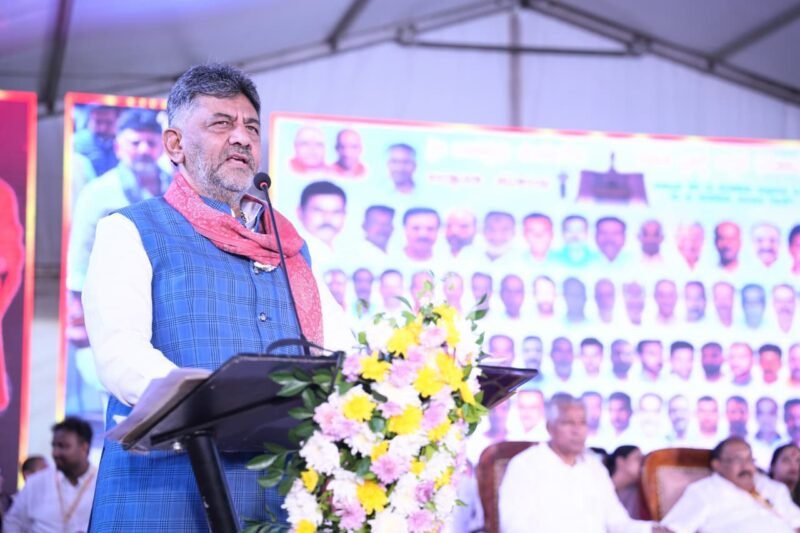
He was speaking on Friday after launching the ‘Chief Minister’s Rural Road Connectivity Scheme’ and the ‘Chief Minister’s Rural Development Scheme’ at the Banquet Hall in Vidhana Soudha.
“Such a huge grant has been provided to change the lives of rural people,not for the betterment of contractors or to fill their pockets.
Not a single rupee of this grant should be misused. Transparency and quality in works are mandatory,” he strictly instructed officials.
Officials instructed to send periodic videos and photos of works :
“Before starting every work,videos and photographs of the site must be captured and recorded in the file.Photos after the completion of the work must also be collected.
Exact coordinates of the work site should be recorded. No work should be taken up without a tender process.
The progress of works will be monitored through the Chief Minister’s Dashboard.Photos of officials conducting site inspections must be published in local newspapers.
WhatsApp groups should be created at every panchayat and district level to share details of the works,”he stated.
“It has come to my notice that funds are being spent again on roads that are already in good condition,bills are being claimed without executing work,and money is being misused in collusion with officials.There will be no scope for such irregularities anymore,” he gave a stern warning to officials.
₹10,000 crore for 15,000 km road development :
“Under the Chief Minister’s Rural Road Connectivity Scheme, ₹10,000 crore has been set aside to develop about 15,000 km of roads.
Various works including road re-asphalting, gravel road development, and drain construction will be undertaken.
Depending on the nature of the work, the cost is estimated at ₹38 lakh to ₹70 lakh per kilometre.Already, ₹5,000 crore in grants has been provided under the Pragathi Patha scheme,” he said.
“₹6,000 crore has been reserved for panchayat-level development.This money will be used for drains, drinking water, and essential infrastructure.
Grants will be released with the permission of the Deputy Commissioners after identifying which works are required in which panchayat.
This is the first time such a huge grant is being given to the Rural Development Department, which is a record,” he added.
5 lakh sites to be distributed in the first phase :
“The government aims to distribute a total of 15 lakh housing sites across the state.It has been decided to distribute 5 lakh sites in the first phase,for which about 9,000 acres of land have been identified.
A plan will be formulated after realistically assessing the cost of infrastructure such as roads and drains required to develop these sites,” he explained.
30×40 dimension sites for the poor as well :
“Henceforth,the Cabinet has decided to fix the minimum dimension of sites allotted to the poor at 30×40 feet. Earlier, 20×30 feet sites were given.
However, as families grow,the space becomes insufficient to build a house, and we must ensure new slums are not created.
With the intention that children of the poor should also be able to build good houses in the future, it has been decided to provide 30×40 feet sites.
If necessary, larger sites will be given even if it means reducing the total number of sites. Priority must be given to homeless families while allotting sites. Those who already own a house or a site should not be given the benefit again,” he clarified.
“Comprehensive development of Karnataka is possible only if villages develop.The government’s priority is to provide necessary basic infrastructure within villages to stop rural people from migrating to cities in search of jobs, education,and a better life,”he said.
Rural development to curb migration to cities :
“Mahatma Gandhi had said that the soul of India resides in its villages.It is our belief that the state’s development is possible only when villages progress.
I have also worked as a Zilla Panchayat member.I am aware of the problems faced by rural people and the hardships local body representatives face due to a shortage of funds.
Therefore,such a large grant has been provided to give greater financial strength to panchayats,”he noted.
“Experts have submitted a report stating that 47% of the population has already shifted from rural areas to cities, and this proportion is likely to rise to 76% in the coming days.
Farmers’ children are leaving their villages in search of jobs, education, and a better standard of living.
To curb this migration, good roads, drinking water, education, healthcare, and employment opportunities must be created right in the villages,”he said.
Rural development is the top priority :
“Industries and job opportunities must be created in rural areas.Panchayats should not cause unnecessary harassment to those coming forward to set up enterprises in villages.
Special policies are also being formulated and implemented for the development of the coastal and Malnad regions,”he stated.
“Rural development is just as important as urban development.Government offices and panchayats must become centres that resolve people’s difficulties.
Priority must be given to basic issues of the public, including roads, drinking water,housing sites,and Khata.
This ₹16,000 crore is meant to transform the lives of rural people. Officials must work considering this their duty,” he urged.
Opportunity for two crore people to rectify property documents :
“Under the Bhoo Guarantee scheme, priority must be given to rectifying property documents in rural areas and providing Khata to eligible beneficiaries.
Around two crore people in the state have the opportunity to resolve property document issues, including A-Khata and B-Khata.
Officials must visit every house, verify property measurements, photographs, and documents, and issue the Khata,” he said.
“Fake registrations must not be allowed.The system to cancel illegally created documents has been strengthened.
Separate counters should be opened in every panchayat to receive and dispose of applications.The situation where people have to run from pillar to post to offices for minor documents must be avoided,”he instructed officials.
CSR support for the development of 1,000 government schools :
“There are about 6,000 panchayats in the state, and we aim to develop at least 3,000 panchayat-level schools. In the first phase, 1,000 schools will be upgraded.
Industries should adopt schools and provide buildings, infrastructure, and necessary facilities.Maintenance of the schools will be the government’s responsibility.
Industries should not just donate money, but come forward to directly develop the schools,”he appealed.
Repair RO plants at the earliest :
“Providing clean drinking water in rural areas is a top priority of the government. Earlier, over 300 RO plants were set up using personal funds and through trusts, and some were handed over to panchayats. However, there is information that they are not being maintained properly in several places.
Defunct RO plants must be repaired immediately. Water quality testing must be conducted every month. CEOs, EOs, and PDOs must take this responsibility seriously and ensure people get clean drinking water,” he said.
“The state has suffered a loss of around ₹60,000 crore due to drought. We have sought ₹22,000 crore in relief from the Central Government.
A decision was taken to provide ₹5,000 relief to each farmer, out of which ₹2,500 has already been released. The remaining amount will be released in the next phase. Our legal battle will continue to secure rightful compensation from the Centre,” he informed.
“Along with the guarantee schemes, thousands of crores of rupees are being spent on various programmes including electricity subsidies for farmers, drinking water, pensions, and the welfare of Scheduled Castes and Scheduled Tribes. In a budget size of around ₹4.5 lakh crore, priority has been given to the development of all sections,” he said.
No room for political pressure on officials :
“CEOs,EOs,PDOs, and other officials must respond to public grievances. If there is unnecessary pressure from MLAs or Ministers, it can be confidentially brought to the government’s notice through the Deputy Commissioners or CEOs. Officials must work strictly according to the law without fearing anyone.
The government prioritizes policy, honesty, and quality of work over caste,”he stated.
“Ministers must visit taluks twice every month. MLAs must listen to public grievances at the hobli and panchayat levels.
I will also visit one Praja Seva Kendra every Saturday. Officials should receive public applications and resolve as many issues as possible on the spot. The day-to-day activities of officials should also be known to the public,” he concluded.


