Siddarth Sethia
*Drought Impact Across Nearly All 240 Taluks; Jowar, Ragi,Tur,Sunflower,Maize and Other Crops Damaged.
*Farmers Must Be Protected from Distress; Drought Management Is Our First Priority.
*Government Taking Necessary Measures After Comprehensive Review of Drought Situation and Farmers’ Distress.
*Action Against Crop Insurance Companies That Fail to Pay Farmers; 8,931 Farmers Enrolled in Sandur.
*Fodder for Livestock: ₹25 Crore Already Released; Another ₹33 Crore to Be Provided.
*Farmers Must Receive Crop Insurance Dues; Action Against Defaulting Companies.
*FIRs to Be Registered if Microfinance Institutions Harass Farmers: DyCM.
Deputy Chief Minister and Revenue Minister Dr.G. Parameshwara said Karnataka is facing one of the most severe droughts seen in the past 75 years, leaving farmers in deep distress.
“I am visiting drought-affected areas across the State to personally assess the ground situation, hear farmers’ problems directly and ensure that the Government provides the necessary support”, he added.
He was speaking after inspecting a maize field at Bandri village in Sandur taluk of Ballari district and interacting with farmers.
Dr. Parameshwara said that most people of the present generation may not have witnessed such a drought in their lifetime.
No part of the State has remained completely unaffected, and almost all of Karnataka’s nearly 240 taluks are facing drought-related distress in one form or another.
Farmers are going through severe hardship, with crops such as jowar, ragi, sunflower and tur damaged across different regions due to lack of rainfall.
He said similar conditions were seen during visits to taluks in the Mysuru region.
In Halakundi village in the Ballari region, tur crops sown by farmers had been completely damaged.After the tur crop failed,some farmers sowed jowar when a little rain was received,but even that crop dried up after barely producing two leaves.
During the inspection of a maize field in Bandri village, it was found that the crop had dried due to insufficient rainfall and had also been affected by pests.
The crop had deteriorated to such an extent that it would neither provide any yield to the farmer nor be suitable for use as fodder for cattle.
The drought situation is being directly reviewed across different parts of the State.
The Chief Minister is inspecting one region, I am visiting another, and officers are touring various areas to assess the situation.
We are seeing the ground reality first-hand to determine how best the Government can support farmers, Dr. Parameshwara said.
The Government is working with the objective of doing everything possible to protect farmers from this crisis and provide them with assistance, he said.
Officials of the district administration, including the Deputy Commissioner, Zilla Panchayat Chief Executive Officer and Agriculture Department officers, have been instructed to treat drought management as their first priority.
They have been asked to focus on resolving drought-related problems before other administrative matters.
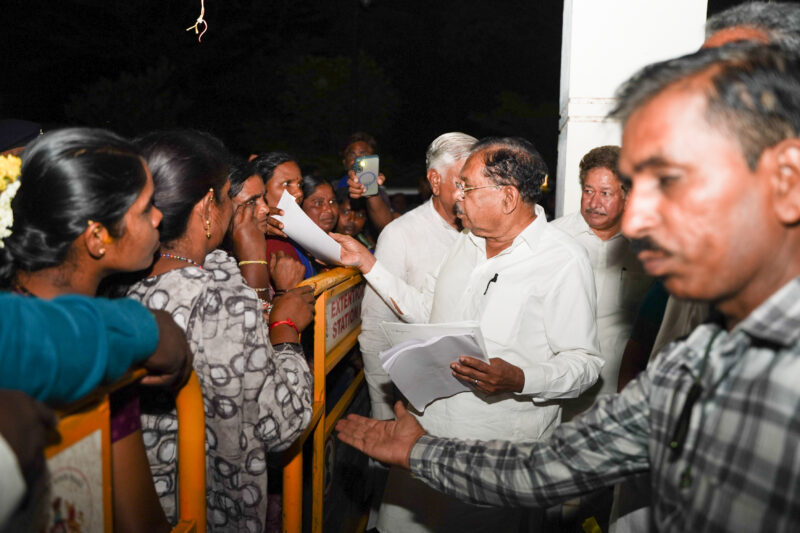
Dr. Parameshwara then invited farmers to speak openly about their problems, saying, “I have come all the way from Bengaluru to listen to your difficulties.
Before telling you what the Government is doing, I want to hear directly about the problems you are facing.I have come here to listen to your grievances.”
Farmers Nagaraj, Eshwarappa and Mailesh requested the Government to relax rural employment scheme norms to prevent migration, issue strict directions to banks not to recover loans and interest, take the drinking water problem seriously, provide fodder for livestock, formulate permanent irrigation projects and implement long-term solutions to drought.
The farmers also noted that even during the present crisis, the Government has continued all five Guarantee schemes, including Gruha Lakshmi, without interruption.
They said Gruha Lakshmi assistance had continued to reach their accounts even during the drought and expressed appreciation that the Government had come to their village to personally assess the situation.
I Stand With Farmers; Our Government Stands With Them:
After hearing the farmers’ grievances, Dr.Parameshwara said Karnataka is facing a severe drought this year and that protecting farmers and livestock from the crisis is the Government’s foremost priority.
He assured them that the Government would under no circumstances abandon farmers,the poor or people living in rural areas.
He said he was visiting various taluks in Ballari and Vijayanagara districts, and would later visit Raichur and Koppal districts, personally inspecting drought conditions across around 10 to 15 taluks.
Teams from the Union Government,along with State officials, have also visited these regions to assess the severity of the drought.
Information had been available as early as April and May that rainfall might be inadequate this year and that drought conditions could emerge.
By June, the seriousness of the situation had become clearer. A meeting was held with the Chief Minister in Kalaburagi to review conditions across seven to eight districts in that division.
Subsequently, the situation in another seven to eight districts was reviewed in Belagavi in discussions with officials and farmers.
“A meeting relating to the Bengaluru division was also held in Chitradurga. In addition, the Chief Minister and I have separately visited various districts to assess the ground situation,” he said.
It became clear very early that farmers would struggle to obtain a proper harvest this year. Crops including ragi, jowar and sunflower have failed to provide adequate yields.
If farmers do not get a crop, it will also affect food supply. In the next two to three months, the State may have to procure essential grains such as rice and ragi from other States.
The Government must also ensure adequate grain supply for the Public Distribution System, including Anna Bhagya.
Along with crop losses, drinking water shortages are becoming serious in several parts of the State. Borewells are drying up and water levels in tanks are falling.
Immediate measures have therefore been initiated to prevent acute drinking water shortages in villages.
Officials have been directed to take necessary measures such as drilling new borewells wherever groundwater is available and supplying water through pipelines from distant tanks or other water sources, he said.
The Government has not merely issued instructions; it has provided ₹306 crore for drinking water arrangements.
₹1 crore has been provided to each Assembly constituency, and another ₹1 crore will be provided wherever necessary.
An initial amount of ₹5 crore per district has been provided for emergency measures.
Across the State, Deputy Commissioners currently have a total of ₹329 crore available for immediate use, while the Ballari Deputy Commissioner has around ₹7 crore at disposal.
Deputy Commissioners have been instructed that if any village faces a drinking water crisis, they should not wait for further Government approval but immediately utilise the available funds.
Funds have already been provided to Ballari district for drinking water and emergency drought management, and this will be increased further depending on the situation.
₹1,250 Crore for ₹2,500 Assistance Each to 50 Lakh Farmers:
To ensure that farmers who have lost their crops receive at least some immediate financial relief, the Government has decided to provide ₹2,500 each as the first instalment of assistance.
Around 50 lakh farmers are expected to receive this support, for which ₹1,250 crore has been released.
The relevant files have been approved, and the process of directly transferring the amount to farmers’ bank accounts through the Deputy Commissioners will begin shortly, he said.
“We are aware that ₹2,500 is not sufficient for a farmer. But assistance must reach all eligible farmers across the State equally.
We cannot provide support to some and leave others out.That is why this assistance is being given in the first phase,”he said.
Under Union Government norms, farmers are eligible for around ₹8,500 per hectare as relief. Without waiting for the Centre’s share, the State Government has provided the first instalment of assistance from its own resources, he said.
Farmers Must Receive Crop Insurance; Action Against Companies That Fail to Pay:
Responding to farmer Eshwarappa’s concern regarding crop insurance during the interaction,Dr.Parameshwara said farmers must receive the compensation due to them in accordance with the insurance they have taken.
Strict action will be initiated against insurance companies if they fail to pay farmers the amount they are entitled to.
Around 8,931 farmers in Sandur taluk have enrolled for crop insurance.
Officials have been directed to calculate the compensation due to each farmer based on the crop insured, the extent of crop damage and the insured amount.
In cases of crop damage, including maize, around 5,305 farmers have already received nearly ₹1.5 crore as advance insurance compensation.
The Government will take steps to ensure that the remaining farmers also receive the insurance amount legitimately due to them.
“We will ensure that farmers receive the insurance money they are entitled to.If insurance companies try to evade their responsibility, action will be taken against them,”he said.
Around ₹60,000 Crore Loss; ₹8,000–₹10,000 Crore Assistance Sought from Centre:
The State has already declared 217 taluks drought-affected, and the overall loss is estimated to have reached nearly ₹60,000 crore.
The first memorandum submitted to the Centre covered the situation in around 117 taluks and detailed losses of approximately ₹40,000 crore.
Subsequently, losses from additional taluks were included, taking the total estimated loss to around ₹60,000 crore, he said.
However, the State Government is not seeking the entire ₹60,000 crore as relief.
Assistance has been sought strictly in accordance with the NDRF guidelines and calculations prescribed by the Union Government.
Under those calculations, the State is eligible for around ₹8,000 crore, and a request has been made to the Centre for approximately ₹8,000–₹10,000 crore in assistance, he said.
The Central team that visited Karnataka has inspected the drought situation and has also seen first-hand that the State is facing a genuinely severe drought.
Once the team submits its report, the relief amount will be decided at the level of the Union Home Ministry, he said.
During the previous drought, although the State Government had sought assistance, no funds were released initially.Later, following the court’s directions, around ₹3,500 crore was released.
This time, since the Central team itself has seen the situation on the ground, there is confidence that Karnataka will receive fair assistance, he said.
Decision to Take an All-Party Delegation to the Centre:
The Chief Minister has decided to take an all-party delegation, including representatives of the BJP, JD(S) and other parties, to Delhi to seek drought relief from the Centre.
Representatives of all parties will be taken together to explain the State’s situation to the Union Government and press for the release of fair and legitimate assistance, he said.
“At a time of such crisis, seeking assistance from the Centre is our right.The Centre must provide the State its rightful share.
How much it ultimately provides is for the Centre to decide, but we will ask for what we are entitled to. At the same time, we will use the resources available with us to provide the maximum possible assistance to farmers,” he said.
Fodder for Livestock: ₹25 Crore Released, Another ₹33 Crore to Follow:
The Government is taking the condition of livestock as seriously as that of farmers.Human beings can say when they are hungry or thirsty, but animals cannot express their suffering. We must not allow a situation where they are left without fodder or water,” he said.
An initial ₹25 crore has been released to address fodder shortages, and another ₹33 crore will be provided in the next phase.
Farmers who have access to water are being provided with seed kits to grow fodder. In Sandur taluk alone, around 2,725 fodder kits have been distributed.
Farmers can grow the fodder required for their own livestock. If surplus fodder is produced, the Government is ready to purchase it. “They need not give it free of cost. The Government will purchase it by paying them,” he said.
Fodder kits have already been distributed in some parts of the State, and substantial quantities of fodder have been grown over the past two to three months.
If the situation becomes more serious, fodder banks will be opened based on reports from Deputy Commissioners, CEOs and Agriculture Department officials.
If necessary, fodder will be procured from Andhra Pradesh, Tamil Nadu, or paddy-growing regions within Karnataka such as Gangavathi and Sindhanur.
Along with fodder banks, cattle shelters will also be opened wherever required. “We will not allow our livestock to die.
Nor will we allow a situation where animals have to be sent to slaughterhouses because there is no fodder,” he said.
More Employment Within Villages to Prevent Distress Migration:
Dr.Parameshwara said the Government has taken seriously the concerns raised by farmers about young and middle-aged people leaving villages and migrating to other districts and States in search of daily-wage work because of the drought.
“A situation should not arise where young people leave the elderly behind in villages and migrate to coffee estates, Goa or other places for employment.
This year, even the Malnad region has received inadequate rainfall, and employment conditions there are also not favourable,”he said.
Officials have been instructed to generate more person-days under the rural employment programme.
In Bandri village, 277 person-days have already been generated, while around 21,000 person-days of employment have been provided across the district.This will be increased further.
The Government’s objective is to provide as much employment as possible locally so that people are not forced to leave their villages in search of work, he said.
Even though the Centre has not released funds under the rural employment scheme, the State Government is making its own financial arrangements, considering the seriousness of the drought, and providing employment to people.
In view of the drought, measures have also been taken to defer recovery of farmers’ bank loans.
Instructions have been issued to provide a moratorium of 60 months, or five years, during which farmers should not be asked to repay their loans, he said.
“Banks should not trouble farmers during this period. The Government will also examine the issue of interest. Farmers should not be put under pressure to repay loans at this stage,” he said.
FIRs if Microfinance Institutions Harass Farmers:
Dr. Parameshwara warned that private microfinance institutions must not visit farmers’ homes and harass them for loan recovery.
Farmers were advised to immediately inform the Deputy Commissioner if any microfinance institution threatens them, enters their homes or subjects them to harassment.
Agriculture Department officials have been directed to continuously monitor the issue.
“If any microfinance institution is found harassing farmers, an FIR must be registered immediately and action initiated against those responsible,” he instructed officials.
Multi-Village Drinking Water Project for 60 Villages:
Responding to a question during the interaction about the multi-village drinking water project, Dr. Parameshwara said the work is expected to be completed by March. The project will provide drinking water to around 60 villages, he said.
Around ₹2,640 crore has been spent on a project aimed at providing a permanent drinking water solution to five taluks by carrying water up to Pavagada.
Several villages in the Pavagada region are already receiving water, and the benefits of the project will similarly reach the remaining areas, he said.
“There is no need to worry that water has reached another taluk but not yours. Work is underway to provide water to all taluks and villages covered under the project,” he said.
*We Will Not Abandon Farmers or the Poor Under Any Circumstances:*
Keeping in mind the possibility that the impact of the drought may continue until May–June next year, the Government is making long-term preparations. Even if there are occasional showers in between, unless there is sufficient rainfall to fill tanks and other water bodies, problems relating to drinking water, fodder and employment may continue, Dr. Parameshwara said.
“Despite our own financial difficulties, we must support the farmer. We must protect farmers and livestock,” he stressed.
He said the purpose of visiting different parts of the State and seeing the situation first-hand was also to instil confidence among farmers that “the Government is with you”.
“Under no circumstances will the Government abandon farmers, the poor or people living in rural areas. The Government stands with you and will respond to your difficulties by providing the necessary support,” he assured.