Vinod M Jain
*No negligence in drought management will be tolerated: Dr.G.Parameshwara.
*All 6 taluks of Vijayanagara and 5 taluks of Ballari drought-hit; drinking water, fodder and employment accorded top priority.
*Agricultural crops damaged across 2.71 lakh hectares in Vijayanagara and over 67,000 hectares in Ballari.
*Strict instructions to ensure crop insurance and SDRF compensation reach farmers at the earliest.
*No delay in drinking water works; Deputy Commissioners directed to immediately utilise disaster relief funds.
*Speed up distribution of fodder kits; create local employment to prevent distress migration.
*Prepare comprehensively until next summer to tackle the impact of El Niño: DCM.
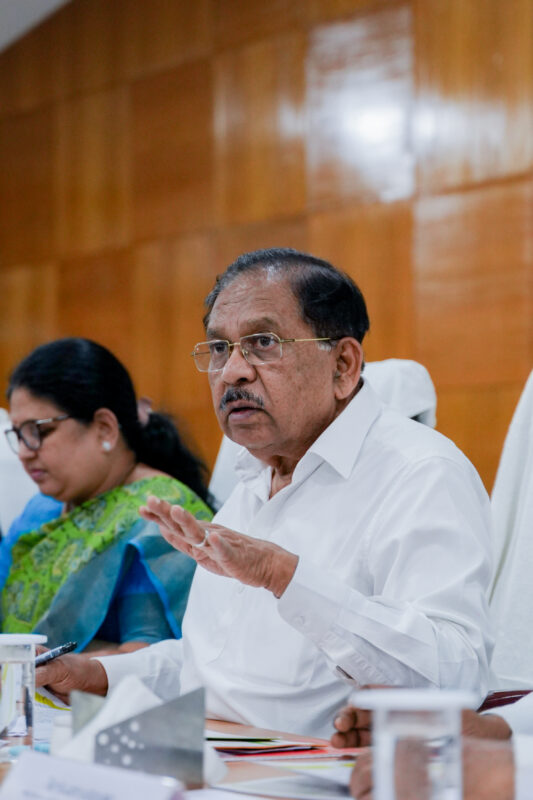
Vijayanagara:Deputy Chief Minister and Revenue Minister Dr.G.Parameshwara today chaired a review meeting at the Vijayanagara Deputy Commissioner’s Office on the drought situation in Ballari and Vijayanagara districts.
He reviewed measures undertaken for drought management, including drinking water supply, fodder availability and employment generation, and issued necessary directions to officials.
The drought situation in the State is extremely serious, and farmers and the general public are facing severe hardship.
Officials and elected representatives must not, under any circumstances, take drought management lightly. Dr. Parameshwara issued strict instructions that providing drinking water for people and livestock, fodder, employment and necessary relief must be taken up on the highest priority.
Review meetings on the drought situation have already been held in the Bengaluru, Belagavi and Kalaburagi revenue divisions.
He said that he had personally conducted field inspections in the Belagavi division as well as in Chitradurga, Tumakuru, Chikkaballapur, Kolar, Mysuru and Chamarajanagar districts.
As per the criteria prescribed under the Union Government’s Drought Management Manual–2020, drought has been declared in phases based on rainfall deficiency and declining groundwater levels.
Of the State’s 240 taluks, 217 have been declared drought-hit — 101 in the first phase, 23 in the second, 53 in the third and 40 in the fourth phase.
57% Rainfall Deficit in Vijayanagara; All 6 Taluks Drought-Hit:
Vijayanagara district has recorded an overall rainfall deficit of 57%.
Hosapete has recorded a deficit of 63%, Harapanahalli 62%, Hadagali 59% and Hagaribommanahalli 57%.
All six taluks of the district have been declared drought-hit.
According to the Agriculture Department, crops including maize, ragi, jowar, groundnut, bajra, tur, and sunflower have been damaged across approximately 2,71,094 hectares in Vijayanagara district.
Under the Horticulture Department, onion, chilli and tomato crops have been damaged across 6,123 hectares, and ground-truthing surveys have been conducted in 37 villages.
Maize has suffered the highest crop damage, with 1,55,011 hectares affected. Ragi has been damaged across 16,958 hectares, jowar across 5,944 hectares and tur across 2,883 hectares.
Among horticultural crops, onion and chilli have suffered significant damage. Officials were directed to identify affected farmers and provide appropriate guidance on alternative crops for the next season.
A total of 1,65,359 farmers in Vijayanagara district have enrolled for crop insurance. Officials were instructed to ensure that insurance compensation reaches eligible farmers directly and without delay.
A total of 3,45,287 farmers in the district have suffered crop losses. Of them, 95,450 are marginal farmers, 56,183 are small farmers and 2,16,514 belong to other categories.
Of the district’s 4,38,405 agricultural plots, only 3,31,587 have been added to the FRUITS portal. Agriculture Department officials were directed to immediately update the details of the remaining farmers.
Expedite Drinking Water Works:
Drinking water problems have been identified in 38 villages in Vijayanagara district,and 46 private borewells have been hired.
Twenty-five private borewells are being utilised in Harapanahalli,while water is being supplied through tankers at Adavi Suravanahalli in Kudligi taluk.
₹4 crore has already been released under the task force for drinking water management, while ₹5 crore per constituency has been provided in the second instalment.
Dr.Parameshwara directed officials to ensure that people and livestock do not face drinking water shortages under any circumstances.
Of the 106 drinking water works undertaken with the ₹4 crore allocation,only 80 have been completed.₹2.86 crore has been spent so far.Officials were instructed to complete the remaining 25 works expeditiously on priority.
Groundwater levels in the district have fallen sharply. Compared with last year, groundwater levels have declined by 11.70 metres in Hadagali, 9.67 metres in Harapanahalli and 9.48 metres in Hagaribommanahalli.
As the problem could become more severe by next summer, officials were directed to begin preparations immediately.
*Fodder Available for 41 Weeks; Encourage Further Fodder Cultivation.
Officials informed the meeting that Vijayanagara district currently has approximately 6,24,204 tonnes of fodder, sufficient for the next 41 weeks.
The market price of jowar stalks, maize, ragi and paddy straw ranges between ₹10,000 and ₹12,000 per tonne, while the government’s revised rate has been fixed at ₹7,000 per tonne.
A total of 16,623 fodder seed kits of 5 kg each have been provided to farmers with irrigation facilities.
These are expected to cover around 1,400 hectares and produce approximately 45,000 tonnes of green fodder. Officials were instructed to further promote such measures.
Increase MGNREGA Works to Prevent Distress Migration:
Dr.Parameshwara said that MGNREGA works are extremely important during drought to prevent people from migrating in search of employment.
Vijayanagara district has 3.4 lakh active MGNREGA workers, and 27.74 lakh person-days of employment have been generated so far.
While Hadagali taluk has achieved 100.04% of its target, Kudligi has recorded progress of only 24.07%.
Officials were directed to immediately increase works in Kudligi and ensure employment is available locally to everyone who seeks it.
49% Rainfall Deficit in Ballari; 68% in Sandur:
Ballari district has recorded an average rainfall deficit of 49%, with Sandur taluk recording a deficit of 68% and Kampli 65%.All five taluks of the district have been declared drought-hit.
Although sowing has been completed across 84.50% of the targeted 1,34,809 hectares in Ballari district, cotton, maize, paddy, tur and sunflower crops have been damaged across 67,236 hectares.
Under the Horticulture Department, onion and chilli crops have been damaged across 4,520 hectares. According to the survey, 96.87% of the plots have suffered crop losses exceeding 50%.
Cotton has been damaged across 26,513 hectares in the district, resulting in an estimated loss of around ₹237 crore to farmers.
Maize has been damaged across 15,766 hectares and paddy across 9,941 hectares.
Chilli has been damaged across 3,780 hectares in Siruguppa,while onion losses have been recorded across 497 hectares in Kampli and 150 hectares in Sandur.
According to a report by scientists from the University of Agricultural Sciences, severe soil moisture deficiency, flower shedding and pollen sterility have resulted in yield reductions of between 85% and 90%.
Dr.Parameshwara directed officials to ensure that government relief reaches such farmers urgently.
Ten villages in Ballari district have been identified as facing drinking water problems, and five private borewells have already been hired — two in Ballari taluk and three in Sandur.
The drinking water situation is particularly severe in Badanahatti,Hale Vaddinakatte,H.K. Halli,Bandri and Chornur villages.
Officials were directed to personally visit these villages and ensure adequate water supply.They were also instructed to prepare an advance action plan to prevent the situation from worsening in the coming days.
Ballari district currently has sufficient fodder for 24 weeks. Although 8,805 fodder seed kits have been supplied to the district, only 1,149 have been distributed.
Expressing displeasure over the extremely low distribution rate, Dr.Parameshwara directed officials to accelerate distribution immediately,warning that disciplinary action would otherwise be initiated against the officials concerned.
Ballari has 2.74 lakh active workers, and 9.28 lakh person-days of employment have been generated at a cost of ₹22.16 crore.
Officials were instructed to ensure employment is available to everyone locally and that there is not even a single day’s delay in wage payments.
*State Providing ₹2,500 Relief Even as Central Assistance is Awaited.
The drought situation in the State is becoming increasingly serious,with forecasts indicating below-normal rainfall during the rabi season as well. ₹25 crore has already been released to the Animal Husbandry Department for the distribution of fodder kits.
As the Union Government is yet to release relief to farmers under the NDRF, the State Government is providing ₹2,500 in compensation to every eligible farmer from its SDRF funds, Dr. Parameshwara said.
Supporting Farmers through ‘Negila Yogi’ and ‘Raitha Mitra’ Programmes:
The ‘Negila Yogi’ scheme is being implemented to bring financial stability and self-reliance to farmers during the drought crisis.
The scheme aims to provide technical and financial support for agricultural activities, including agricultural machinery at subsidised rates or direct financial assistance.
For farmers holding less than three acres, the proposal is to provide an incentive of ₹500 per activity for a maximum of three activities per acre in a year, up to a maximum of ₹4,500 for three acres, through Direct Benefit Transfer (DBT). A dedicated mobile application and web portal are being developed for the programme.
In addition, the ‘Raitha Mitra’ programme is being implemented to familiarise farmers with weather- and market-based agricultural practices, ensure government benefits reach them directly, and ensure officials move beyond their offices and respond to farmers directly in their fields.
Basic Needs of People and Livestock Are the Government’s First Responsibility:
Dr. Parameshwara said that ensuring the basic needs of people — including drinking water, food, employment and healthcare — as well as water and fodder for livestock is the responsibility of the Government.
The Revenue Department must coordinate with all other concerned departments to ensure that problems do not arise.
Water available in reservoirs must be used sparingly and responsibly. No village or urban area should face a shortage of drinking water.
During periods of water scarcity, people tend to store water for longer durations, increasing the risk of dengue and chikungunya.
As Vijayanagara district has reported 30 dengue cases and seven chikungunya cases since January 2026, the Health Department was directed to create adequate public awareness.
Meetings of the task force and District Disaster Management Authority must be held regularly. As the number of people affected by contaminated water tends to increase during drought years, greater vigilance must also be maintained over water quality.
During El Niño years, there may also be an increased possibility of sudden rainfall, floods and lightning. District administrations must take advance precautionary measures based on weather forecasts.
Adequate stocks of seeds and fertilisers must be maintained to prevent shortages.If sudden rainfall occurs after crops have dried up due to drought, demand for seeds and fertilisers for re-sowing could increase sharply. The Agriculture Department must prepare for such a situation in advance.
The availability of livestock fodder should not be determined merely on the basis of reports. Deputy Commissioners and CEOs must verify the situation on the ground through their teams.
Farmers with access to water sources should be encouraged to cultivate fodder, and fodder seed kits and must be distributed to them.
Officials must also verify whether rain gauge stations are functioning properly.No habitation should face drinking water shortages.
When water is supplied through tankers, precautions must be taken to ensure that prolonged storage of water does not increase the risk of dengue.
Farmers should be encouraged to choose crops that can be cultivated with less water. The emergency allocation of ₹5 crore provided to districts for drinking water must be utilised judiciously.
In the event of water scarcity, officials should follow a clear order of priority: first,responsibly utilise available reservoir water; second, hire private borewells; third, deepen existing borewells where necessary; treat drilling of new borewells as the last priority; and, in unavoidable circumstances, supply water through tankers.
Senior KAS officers have been appointed as taluk-level nodal officers for every taluk in the State, and their services must be utilised eff