Binish Thomas (Special Correspondent)
In May 2026, 42 men in Madhya Pradesh arrived at a mass-wedding venue dressed for the occasion. Every one of them had been shown a photograph of the woman he was told he would marry.
By the end of the day, not a single bride had appeared.
Police subsequently investigated what appeared to be organised fraud.
The photographs, according to the complaints, included images pulled off the internet, and the men had been told the brides would come from an orphanage.
Money had reportedly been collected from the prospective grooms.
The incident was a scam, but it raises a much larger question.
As mass-marriage ceremonies become increasingly elaborate public events across India, who exactly is organising them, who is financing them, and how thoroughly are the people participating in them being verified?.
When Charity Becomes a Spectacle
Mass marriages are not new to India. For economically weaker families, they can provide genuine relief from the enormous financial burden associated with weddings.
Religious institutions, charitable organisations and governments have conducted such ceremonies for decades. What deserves greater scrutiny, however, is the growing scale and publicity surrounding some of these events.
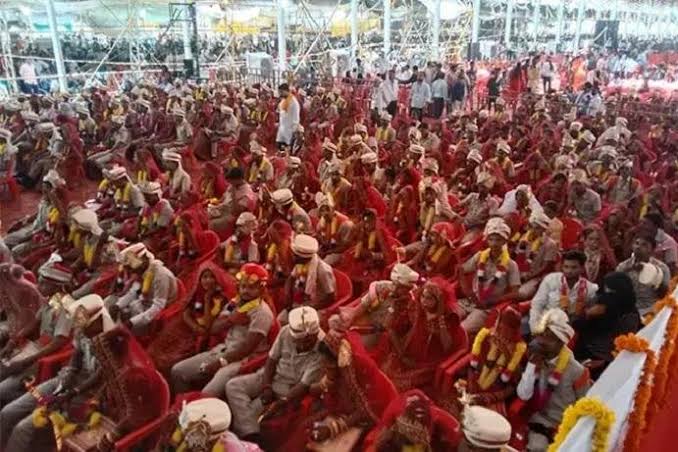
Hundreds of couples may be brought together at large venues, with food, clothing, jewellery, household goods and other gifts being distributed.
Politicians and local notables are invited to the stage, and the photographs travel further than the couples do.
There is nothing suspicious about a politician attending a charitable event. Nor does an expensive ceremony automatically indicate wrongdoing.
But when an organisation spends substantial sums organising hundreds of weddings, the public has a legitimate right to ask where that money comes from.
Is it individual donations?.
Corporate CSR contributions? Government assistance? Religious institutions? Foreign contributions? A donor with something to gain? That isn’t an accusation. It’s the same question anyone would ask of a hospital or a school running on the same numbers.
Where Does the Money Come From?:
India already has laws governing charitable organisations and their finances. Organisations receiving foreign contributions are regulated under the Foreign Contribution (Regulation) Act, 2010 and must maintain accounts and report the receipt and utilisation of such funds.
Charitable institutions receiving tax benefits also have reporting obligations relating to donations.
Yet a basic question remains: is there enough scrutiny when a private organisation conducts a mass marriage involving hundreds of people?.
The public should be able to know who runs such an organisation, how it is funded, how much is spent and whether beneficiaries actually receive what was promised.
Transparency becomes even more important when political figures repeatedly appear at such events. Their presence does not prove political patronage or funding.
But the relationship between organizers, donors and political networks should be transparent enough that the public does not have to guess.
India’s Missing Women:
There is another reason why verification at marriage events deserves serious attention.
India has a significant problem involving missing women and girls.
According to Ministry of Home Affairs data presented to Parliament, more than 13.13 lakh girls and women were reported missing across India between 2019 and 2021, including more than 10.6 lakh women and 2.5 lakh girls.
These figures need to be interpreted carefully.
A missing-person report does not automatically mean kidnapping, trafficking or criminal exploitation. Many missing people are subsequently traced.
Nevertheless, the sheer scale is alarming.India has also recorded cases involving human trafficking and exploitation of women and children.
That makes it particularly important that organisations facilitating large numbers of marriages maintain proper records and verify every participant.
There is no credible evidence establishing a connection between missing women and legitimate mass-marriage organisations.
But that is precisely why the government should ensure that such a connection could never be concealed if one existed.
Could Vulnerable People Be Exploited? :
A mass marriage involves something more serious than a conventional charitable event. It creates a legally and socially significant relationship between two individuals.
Basic questions should therefore be answered before the ceremony:
Who identified the bride and groom?.
Are they both legally eligible to marry?.
Are they adults? Are they genuinely unmarried?.
Are their identities verified?.
Have they consented freely?.
Are their families aware?.
And most importantly, is every marriage subsequently registered and traceable?.
The Madhya Pradesh scam demonstrates how easily marriage arrangements can be turned into organised fraud.
Authorities have also uncovered attempts elsewhere to exploit government-sponsored mass-marriage schemes by falsely claiming benefits or misrepresenting marital status.
These cases do not prove that mass marriages are inherently suspicious. They demonstrate something more important: weak verification creates opportunities for exploitation.
Charity Needs Regulation, Not Suspicion :
The answer is not to discourage genuine charitable organisations from helping poor families.
Mass marriages can reduce financial pressure and provide dignity to families who cannot afford elaborate weddings.
But organisations conducting large-scale ceremonies should face clear transparency requirements.
At a minimum, authorities should consider requiring:
Registration and disclosure of the organisation’s governing body.
Disclosure of major funding sources and event expenditure.
Verification of the identity and age of every bride and groom.
Verification of marital status and free consent.
Compulsory registration of every marriage.
Proper records, photographs and documentation of each ceremony.
Disclosure of government grants and corporate sponsorships.
Independent audits for organisations conducting very large events.
Random post-event verification by local authorities.
Where foreign funding is involved, existing FCRA requirements should be strictly enforced. Where government money or welfare benefits are involved, beneficiary verification should be even stronger.
The Government Should Not Wait for a Scandal :
Most charitable organisations are likely to be doing legitimate and valuable work. But charity should never become a blind spot for regulators.
An organisation handling large sums of money should be accountable. An organisation dealing with vulnerable people should be accountable. And an organisation facilitating hundreds of marriages should face an even higher level of scrutiny.
The Madhya Pradesh scam should therefore be treated as a warning.
It does not prove that mass-marriage organisations are fronts for political parties, criminal networks or trafficking operations.
There is no evidence to make such a sweeping claim. But it does demonstrate how easily the promise of marriage can be exploited.
India already has a serious missing-person problem, documented cases of trafficking and repeated instances of fraud involving marriage schemes.
The government therefore needs to ask some basic questions:
Who is organising these mass marriages? Who is funding them and who are the beneficiaries? Who is verifying that every person standing on that stage is there voluntarily and legitimately?Charity deserves encouragement.
But when charity involves money, identities and vulnerable people, transparency cannot be optional.