Sunil Lohan
*101 taluks to be declared drought-affected; 32 more under review.
*Drinking water supplied to 758 villages through 149 tankers.
*714 private borewells hired; 151 lakh tonnes of fodder available.
*₹25 crore released for fodder seed kits to farmers with access to water.
*Groundwater levels declining; public urged to use water judiciously.
Karnataka is witnessing an unprecedented drought this year.The State Government is spending ₹635 crore to effectively manage the situation and ensure that people and livestock do not face hardship.There is no shortage of funds,Deputy Chief Minister and Revenue Minister Dr. G.Parameshwara said.
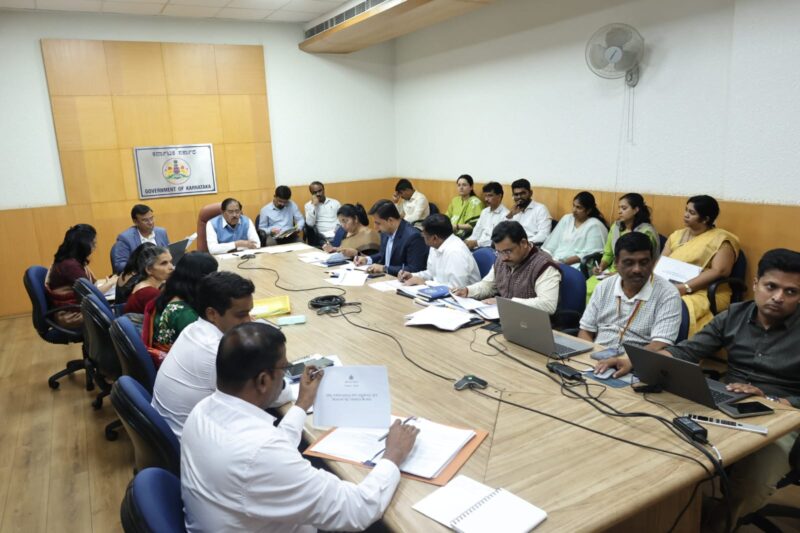
Addressing a press conference at Vidhana Soudha today on the drought situation,he briefed the media on the prevailing conditions,crop losses and the measures being taken by the State Government for drought management.
From June 1 to August 26,Karnataka received only 465 mm of rainfall against the normal 666 mm, recording a 30% deficit.
As many as 29 districts and 190 taluks fall under the Deficit to Large Deficit rainfall categories,with 12 taluks experiencing Large Deficit rainfall.
As of August 26,134 taluks had experienced dry spells of more than three consecutive weeks and qualified for assessment under Trigger-1,he said.
Explaining the drought declaration process,Dr. Parameshwara said the Union Government’s Drought Manual,2020 prescribes several trigger points. Under Trigger-1,a taluk qualifies if it receives no rainfall for three or more weeks,termed dry-spell weeks.
Trigger-2 considers factors such as the extent of sowing, condition of sown crops,soil moisture,groundwater levels and water availability in tanks and reservoirs.
“Based on these parameters,we carried out the assessment and ground-truthing.134 taluks qualified under Trigger-1.
Following ground-truthing,101 taluks have currently qualified to be declared drought-affected. The remaining 32 taluks that qualified under Trigger-1 are under review,” he said.
After the first phase of declaring 101 taluks drought-affected,the situation will be reviewed every 15 days.
Ground-truthing has been carried out hobli-wise and the findings analysed before identifying drought-affected areas.
He pointed out certain limitations in the Union Government’s criteria.“In some taluks,even if there is no rain for two weeks and it rains just once in between,the taluk may lose eligibility under Trigger-1,even though crops may not have grown.
Such problems exist in the present criteria.We have repeatedly urged the Union Government to revise them as was done earlier,but the Centre has not addressed the issue.Therefore,we are compelled to declare drought in phases,”he said.
As of August 21,sowing in the State stood at 71%. Against a target of 84.10 lakh hectares, sowing had taken place in only 60 lakh hectares.
Of the State’s 240 taluks, sowing was below 75% in 104 taluks, and in 42 taluks it was below 25%.
The situation is similar in horticulture.As of August 25, only 3.04 lakh hectares, or 69%, had been covered against a target of 4.36 lakh hectare.
Even crops that have been sown are not achieving expected growth because of inadequate rainfall.
Farmers have therefore been advised to cultivate short-duration varieties suited to deficient rainfall conditions, and seeds have been distributed accordingly.
The prolonged rainfall shortage has also led to a sharp decline in soil moisture.
According to the Moisture Adequacy Index (MAI) as of August 26, 178 taluks, or 74% of the State, are facing severe soil-moisture stress.
Of these, 86 taluks face very severe moisture deficiency and 92 taluks moderate deficiency, adversely affecting the early growth of crops.
Groundwater levels have declined in 132 taluks compared with the average of the previous decade, and there are concerns that levels could fall further in the coming months.
The Government is therefore taking up measures to support groundwater recharge and development.
Dr. Parameshwara urged people to recognise the seriousness of the situation, prioritise groundwater conservation and use water judiciously.
He said reservoir storage during the corresponding period last year stood at 815.70 TMC, whereas as of August 26 this year it was only 684.09 TMC.
As per data available up to August 22, drinking water is being supplied to 758 villages through 149 tankers, while 714 private borewells have been hired.
In urban areas, water is being supplied through 48 tankers to 114 wards across 18 Urban Local Bodies, and 18 private borewells have also been hired.
The Government has estimated that if the situation worsens, 2,059 Gram Panchayats could face drinking water shortages next summer.Necessary preparations have already been made to address such a situation, he said.
According to information provided by Deputy Commissioners and the Animal Husbandry Department, the State currently has around 151 lakh tonnes of fodder, sufficient for approximately 33 weeks.
In 49 taluks, stocks are sufficient for about 25 weeks, while in 18 taluks,fodder availability is sufficient for less than 20 weeks.
The Government has released ₹25 crore to provide fodder seed kits to farmers who have access to water. KMF is also distributing fodder seed kits.
Farmers who have grown fodder have been requested to preserve and conserve it carefully,Dr.Parameshwara said.