Sunil Lohan
*Drought Declared Strictly as Per Union Government Guidelines.
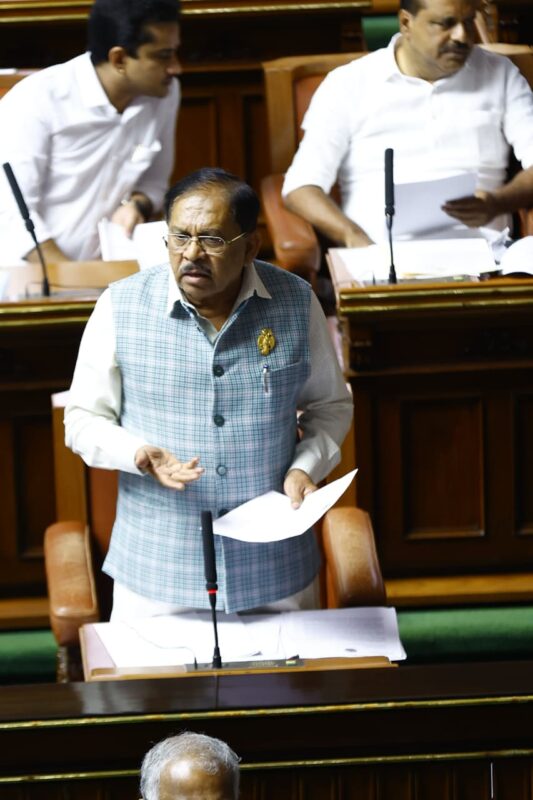
*Deputy Chief Minister and Revenue Minister Dr.G. Parameshwara said the Kasturirangan Report and the severe drought situation in Karnataka must be discussed comprehensively in the Legislature,rising above party lines, to arrive at a consensus that protects the State’s interests.
Speaking in the Legislative Council, he said the State Government is required to submit its views to the Union Government within the stipulated period on the 7th draft of the Kasturirangan Report.
“Rather than the Government submitting its opinion unilaterally,it is appropriate that members of both the ruling and Opposition parties discuss the issue openly in the House and arrive at a consensus in the larger interest of Karnataka.It is with this objective that the matter has been taken up for discussion,”he said.
Severe Drought Across the State:Dr.Parameshwara said the drought situation this year is extremely serious and is not confined to a few taluks.
Severe rainfall deficiency has been recorded across large parts of the State,significantly affecting agricultural activity and farmers’ livelihoods.
The Government is comparing this year’s figures with previous severe drought years and is taking the present situation seriously.
He said the El Niño phenomenon,caused by increased surface temperatures in the Pacific Ocean,has also contributed to the rainfall deficit and has been particularly intense this year.
Karnataka normally receives around 852 mm of rainfall, but only 642 mm has been recorded.
Severe rainfall deficits were reported in several regions during the period from June to September 26,he informed the House.
The State has recorded an average rainfall deficit of 36%, with 46% in South Interior Karnataka,44% in North Interior Karnataka,38% in Malnad and 28% in the coastal region.
Farmers had taken up sowing when the rains initially began,but the rainfall stopped soon afterwards,causing germinated crops to dry up.
In several places,farmers sowed a second time after the rains returned,but those crops too suffered damage. Crop losses have been severe in many areas,leaving farmers in distress,he said.
177 Taluks in Drought-Hit List:Dr.Parameshwara said drought-hit taluks must be declared in accordance with the drought declaration guidelines framed by the Union Government in 2020.
Following these criteria,101 taluks were declared drought-hit in the first phase.
After continued assessment,another 23 taluks were added,and a further 53 taluks are now being included. This will take the total number of drought-hit taluks to 177.
He clarified that the process would not end there. Continuous assessment will be carried out based on ground conditions,rainfall deficiency, crop damage and other prescribed parameters.
More taluks may be added in the next phase, and the total number of drought-hit taluks could rise to around 200,depending on the situation.
Since the Union Government has prescribed the criteria for drought declaration and relief,the State Government must act within those guidelines.
Declaring all taluks drought-hit at once,without meeting the prescribed criteria,could create difficulties in securing relief from the Union Government,he explained.
“We are following the rules framed by the Union Government.The Centre must provide Karnataka the drought relief due to it under those very guidelines.
At the same time,the State Government will not step back from its responsibility and will continue assessing the situation and ensuring relief reaches farmers,”he said.
Dr.Parameshwara appealed to both the ruling and Opposition parties to set aside political differences and hold a comprehensive discussion on the Kasturirangan Report and the drought,as both are crucial issues concerning Karnataka’s interests.
He urged the House to arrive at a united position and present it before the Union Government in the larger interest of the State.