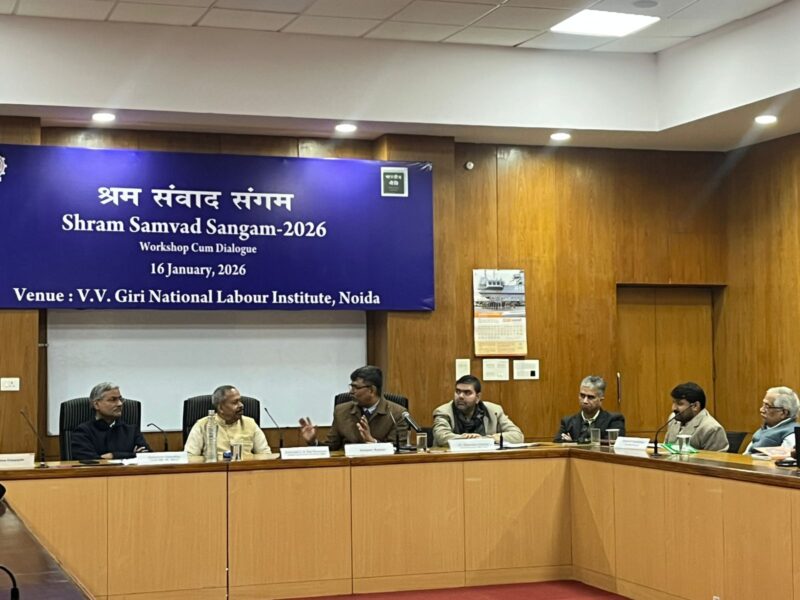
Noida: The Shram Samvad Sangam–2026, a National Workshop-cum-Dialogue aimed at strengthening last-mile labour empowerment, was successfully organised at the V. V. Giri National Labour Institute (VVGNLI), Noida, in collaboration with the Bharatiya Neeti Samvad Kendra (BNSK-Bharat).
The national-level programme brought together policymakers, labour institutions, industry leaders, academicians, and social sector experts to deliberate on effective implementation of India’s Labour Codes in alignment with the vision of Viksit Bharat @2047.
Eminent Speakers Grace Inaugural Session
The inaugural session was graced by Prof. (Dr.) K. G. Suresh, Director, India Habitat Centre, as the Chief Guest, while Advocate C. K. Saji Narayanan—eminent thinker, author, and former President of the Bharatiya Mazdoor Sangh—attended as Guest of Honour. The session was chaired by Dr. Arvind, Director General, VVGNLI.
The plenary panel featured Vinod Sant, former Director General, National Safety Council of India; Debashish Satpathy, Chief General Manager (HR), NBCC (India) Limited; Dr. Dipendra Chahar, Chairman, Regional Committee of DTNBWED, Delhi and General Secretary, BMS–Delhi Pradesh; and Prof. Sanjeev Kumar, Dean, School of Liberal Arts, Bennett University.
Emphasis on Last-Mile Delivery
Addressing the gathering, Aman D. Vashistha, Executive Director, Bharatiya Neeti Samvad Kendra, highlighted that labour is a subject under the Concurrent List of the Constitution, making both the Union and State Governments jointly responsible for implementation.
He noted that while Labour Codes and national digital platforms are in place, the real challenge lies in last-mile delivery. He stressed the need for a “whole-of-institutions” approach involving research bodies, regulators, industry, academia, worker collectives, and civil society to ensure coordinated and effective outcomes.
Shram-Setu 2047: A Community-Led Model
A key outcome of the dialogue was the presentation of Shram-Setu 2047, jointly conceptualised by VVGNLI and BNSK-Bharat. Envisioned as a last-mile delivery and convergence platform, Shram-Setu 2047 is based on a community-led governance model rooted in the principle of “Development of Communities from Within.”
The model draws inspiration from successful grassroots initiatives implemented in South Cachar district of Assam, where community participation led to agricultural revival, livelihood restoration, and educational development. The framework seeks to bridge institutional silos, strengthen Centre–State coordination, and enable district-level implementation through community engagement, institutional synergy, and real-time policy feedback.
Technology and Labour Governance
The Special Session on Tech-Driven Transformation under the New Labour Code Framework further enriched the discussions. Prof. Monika Suri, Dean and Head, School of Humanities and Social Sciences, Jaypee Institute of Information Technology, Noida, highlighted community-led institutional models, citing ArcelorMittal Nippon Steel India, Surat, as a successful example of collaborative labour welfare.
Dr. Bommuluri Bhavana Rao, Assistant Professor, Faculty of Law, University of Delhi, underscored the constitutional foundations of labour rights and stressed the importance of rights-based, accountable implementation of Labour Codes at the grassroots level.
Arun Chauhan, technology leader and Founder of Tech Baton, spoke on the ethical use of Artificial Intelligence in labour governance. He emphasized that responsible AI, transparency in digital systems, and human-centric design can significantly enhance grievance redressal, social security access, and last-mile service delivery without excluding vulnerable workers.
Collective Commitment Towards 2047
The dialogue concluded with a shared consensus that labour empowerment cannot be achieved through isolated efforts. Participants emphasized the need for integrated institutional collaboration, ethical technology adoption, and strong community participation.
The deliberations at Shram Samvad Sangam–2026 reaffirmed the joint commitment of VVGNLI and Bharatiya Neeti Samvad Kendra to work closely with States, institutions, industry bodies, and communities to ensure that the benefits of Labour Codes meaningfully reach India’s workforce as the nation progresses towards Viksit Bharat @2047.