Vivek Sharma
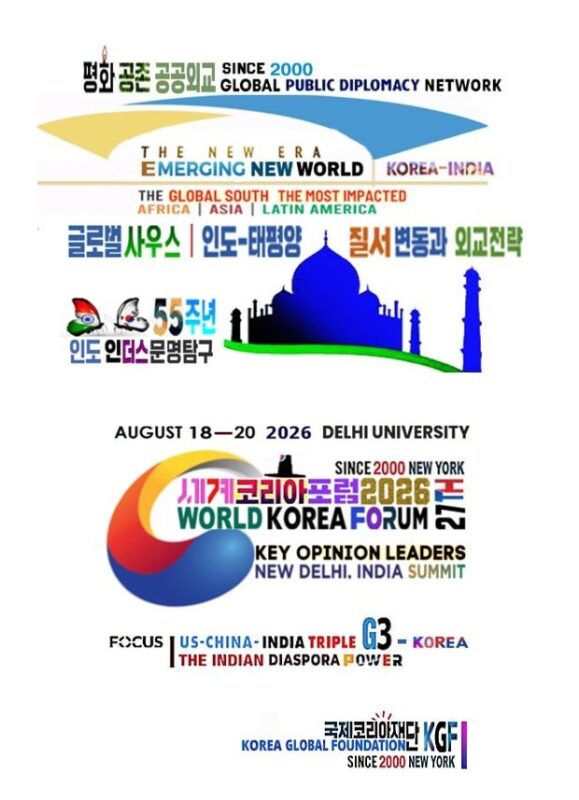
New Delhi, India: New Delhi is set to host the 27th World Korea Forum 2026 from 18 to 20 August 2026,bringing together academics,policymakers,diplomats,geopolitical experts,business representatives and opinion leaders from India,South Korea and several other countries for discussions on the rapidly changing global order.
Organised by the Korea Global Foundation and co-hosted with the University of Delhi,the three-day forum seeks to provide a platform for examining contemporary geopolitical,geoeconomic and cultural transformations and exploring future-oriented cooperation,coexistence,peace and prosperity.
According to the organisers,the choice of New Delhi reflects India’s growing significance in global affairs.
The forum’s background material describes India as a major power across economics,development,military affairs,geography,population,culture,history and diaspora,with the Indian diaspora also playing an influential role across several regions.
The forum comes at a time when strategic competition in the Indo-Pacific is intensifying,with major powers and regional countries increasingly focusing on economic, security and geopolitical interests in the region.
The organisers highlight India’s Act East Policy,its engagement with the Indo-Pacific and its role in platforms associated with the Global South,BRICS and the Shanghai Cooperation Organisation as important elements of the changing regional landscape.
The central discussions of the forum will cover a broad range of subjects,including Korea-India relations,the Indo-Pacific,the Korean Peninsula,international security, the global economy,multilateralism,the Global South, diaspora,culture and future international cooperation.
The opening sessions are scheduled to address the changing geopolitical order and India’s role in the emerging international environment.
The programme includes discussions on the status of Korea-China-Japan studies and education in India, India’s future development,Korea-India relations and strategic solidarity in the Indo-Pacific era.
It also features discussions on strengthening Korea-India diplomatic and economic partnerships in an era of multipolarity.
The forum will also devote substantial attention to the Korean Peninsula and security environment in Northeast Asia.
Sessions will examine denuclearisation, nuclear self-reliance,inter-Korean relations,US-DPRK relations, North Korea’s relations with China and Russia,and India’s interests and strategic role on the Korean Peninsula.
Another major area of discussion will be peace, reconciliation and Korean unification.
Speakers are scheduled to examine the role of multilateral groups and the Global South,India’s perspective on Korean unification,economic engagement between the two Koreas,common security and the prospects for peace on the Korean Peninsula.
The international dimension of the forum will extend beyond the Korean Peninsula.Sessions will explore the evolving international order,the role of great and middle powers in the Indo-Pacific,India’s and China’s perspectives on global changes,relations between India, the EU and emerging powers,and possible reforms to global governance mechanisms.
Scholars and experts from countries including South Korea,India,China,Russia,Italy,Spain,Kazakhstan, Uzbekistan,Kyrgyzstan and the United Kingdom are listed in the programme.
Economic cooperation will form another important component.
Discussions will focus on economic security,fair trade, the political economy of BRICS and the Global South, Korea-India economic cooperation in the Indo-Pacific era,ASEAN political economy, and economic cooperation involving Russia and the DPRK.
The forum will also highlight the contribution of the Korean community and diaspora.Sessions will examine the Korean community in India and its economic and cultural contributions,the meaning and influence of diaspora in a global era,Korean diaspora literature, Indian diaspora and transnationalism,diasporic Koreans and their ethnic homeland,and Korean communities in Central Asia.
Culture and intellectual exchange will provide another dimension to the programme.Sessions include discussions on Rabindranath Tagore,Indian philosophy, culture and civilisation,K-Culture and K-Philosophy, migration and South-South cooperation,and the Gandhi-Nehru political philosophy framework.
The organisers describe the New Delhi forum as an effort to understand a changing world through geopolitical,geoeconomic and cultural perspectives while encouraging dialogue and cooperation among global opinion leaders.
The broader objective is to share the vitality of changing societies and contribute towards a common vision for peace,stability and prosperity in world politics, diplomacy,military affairs,economy,technology,culture and diaspora affairs.
The 27th World Korea Forum in New Delhi is therefore expected to provide a significant platform for India-Korea dialogue and wider international exchange, while seeking to build bridges of public diplomacy and diaspora cooperation during a period of major global transition.
Email id: reporter.cnpn@gmail.com