
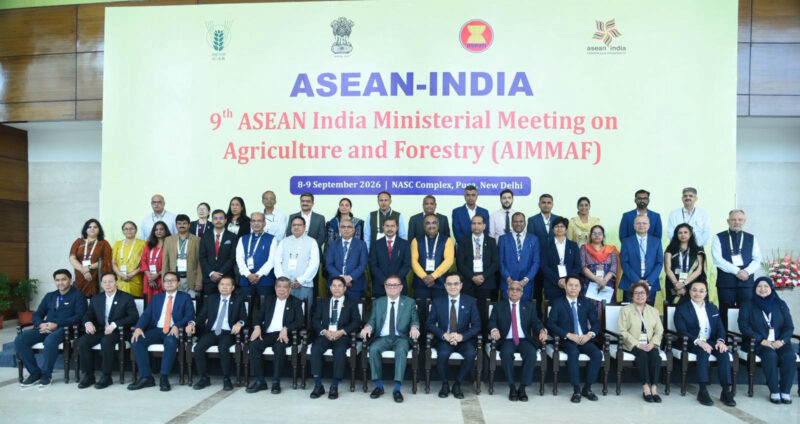
New Delhi: India and ASEAN are moving towards deeper cooperation in agricultural research and development, with a renewed focus on innovation, climate resilience, food security and the exchange of scientific knowledge.
As part of efforts to strengthen India–ASEAN collaboration, six young researchers from the Indian Council of Agricultural Research (ICAR) presented India’s significant achievements in agricultural research and outlined new opportunities for collaborative research and innovation with ASEAN member countries.
The interaction highlighted the important role of scientific cooperation in addressing emerging challenges facing agriculture, including climate change, changing food consumption patterns, natural resource constraints, emerging pests and diseases, and the need to increase farm productivity while ensuring environmental sustainability.
ICAR Research Focus on Food and Livelihood Security
The young ICAR researchers showcased India’s work towards strengthening food, nutritional and livelihood security, with particular emphasis on technologies and agricultural practices designed to benefit farmers and rural communities.
Among the key areas highlighted were the development of climate-resilient crop varieties, biofortified crops, improved agricultural technologies and sustainable production systems. These innovations are aimed at improving productivity and nutritional outcomes while helping farmers adapt to changing climatic conditions.
The researchers also identified several areas where India and ASEAN countries can expand joint research initiatives, including crop improvement, precision agriculture, natural resource management, post-harvest management and sustainable farming practices.
Opportunities in Advanced Agricultural Technologies
The proposed areas of cooperation extend beyond conventional agricultural research and include emerging technologies that could transform farming and food systems.
Potential areas include the use of genomic tools, advanced diagnostics, genome editing and biosafety research, along with collaborative work in animal science, poultry, fisheries and aquaculture.
The discussions also placed emphasis on climate change research, recognising the shared challenges faced by agricultural communities across India and Southeast Asia. Joint research could help develop region-specific technologies, resilient farming systems and innovative approaches to managing natural resources.
Building the Next Generation of Agricultural Scientists
Human resource development emerged as another important pillar of India–ASEAN agricultural cooperation. The collaboration envisages greater opportunities for student exchanges, researcher exchanges, scientific training programmes, institutional partnerships and knowledge-sharing initiatives.
Such exchanges can provide young researchers and students with opportunities to work across different agricultural ecosystems, share scientific expertise and develop solutions to common regional challenges.
The involvement of young scientists also reflects an effort to create a new generation of researchers capable of working collaboratively across national and disciplinary boundaries.
Philippines Reaffirms Support for Stronger Partnership
H.E. Francisco P. Tiu Laurel, Head of the Philippines delegation, appreciated the initiative and reaffirmed the commitment towards strengthening the ASEAN–India partnership for sustainable agricultural development.
His remarks underscored the importance of continued cooperation between India and ASEAN in developing innovative, inclusive and sustainable solutions for the region’s agricultural sector.
Strengthening India–ASEAN Cooperation
India and ASEAN share many common agricultural challenges, including climate variability, food and nutritional security, sustainable management of natural resources and the need to improve farmers’ incomes.
Strengthening research partnerships can therefore play a crucial role in creating technologies and policies suited to the diverse agricultural conditions of the region. Collaborative R&D, scientific exchanges and institutional partnerships can further contribute to food security, sustainable agriculture and resilient rural livelihoods.
The participation of young ICAR researchers has added a new dimension to this cooperation, demonstrating how scientific innovation and international collaboration can come together to address the agricultural challenges of the future.
The India–ASEAN agricultural R&D partnership thus holds considerable potential to advance innovation, sustainability, food security and knowledge exchange, while creating stronger links between researchers and agricultural institutions across the region.


